





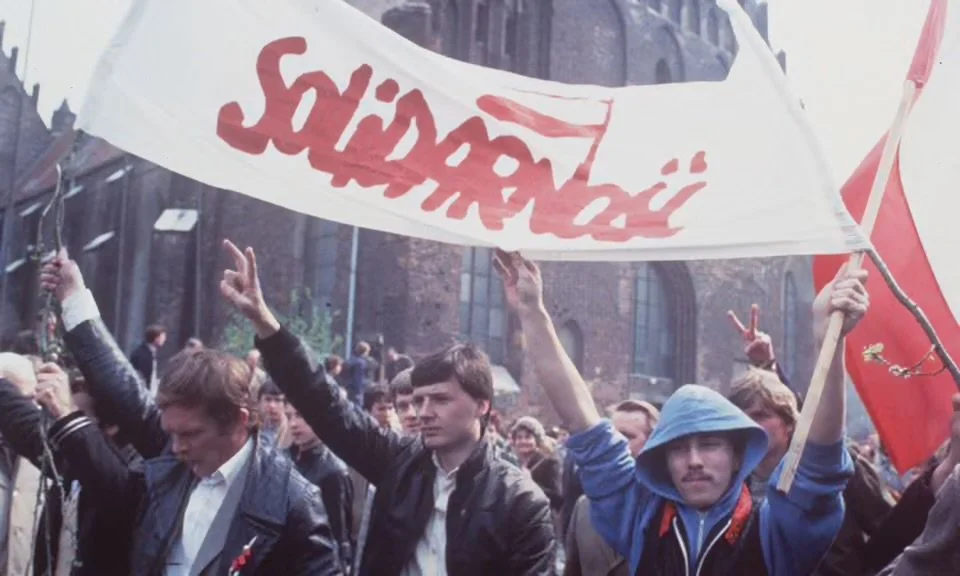
The rhythmic clang of hammers fell silent on the morning of August 14, 1980, at the Lenin Shipyard in Gdańsk, Poland.
For a moment, it was almost eerie.
Cranes stood frozen over half-built ships. Sparks faded from welding torches. Thousands of workers removed their gloves and laid down their tools. The only sounds were murmurs drifting across the yard and the distant cry of seagulls over the Baltic Sea. Nearly seventeen thousand shipyard workers—welders, electricians, riveters, crane operators, and laborers—stood together with folded arms.
Among them was a fifty-year-old crane operator named Anna Walentynowicz. Just five months before qualifying for retirement, she had been fired. Her crime was not theft, violence, or incompetence. She had simply become too outspoken. She defended fellow workers, criticized corruption, and quietly helped organize efforts for independent labor unions. The Communist government expected her dismissal to serve as a warning.
Instead, it became a spark.
Climbing above the crowd so she could be heard, Walentynowicz called out:
“We have had enough!”
Those simple words ignited one of the most important movements of the twentieth century.
Within hours, workers hung hand-painted banners across the shipyard gates. Images of the Virgin Mary and Pope John Paul II appeared beside the red-and-white Polish flag. Flowers accumulated. Candles flickered. The entrance to the shipyard began to resemble both a protest and a pilgrimage.
The strike that began that morning was about more than wages. It was about the dignity of the human person. . .
To understand why this mattered, you have to understand the Poland those workers lived in. When the Second World War ended in 1945, Poland had suffered perhaps more than any other nation in Europe. It had first been crushed beneath Nazi occupation. Then, as the Germans retreated westward, the Soviet Red Army marched in from the east.
Officially, Poland had been liberated. In reality, one totalitarian regime had replaced another.
The Soviet-backed Communist government abolished meaningful political opposition, censored newspapers, controlled radio and television, nationalized industry, collectivized much of agriculture, and built a vast network of secret police informants. Elections became carefully managed performances whose outcomes were never truly in doubt. Speaking honestly could cost someone a promotion, a career, or their freedom.
Yet one institution stubbornly refused to disappear. The Catholic Church.
Unlike many other countries behind the Iron Curtain, Poland remained overwhelmingly Catholic. Churches stayed full. Children continued to be baptized. Families gathered for Mass even while the state preached atheism. Priests often became the only public figures whom ordinary Poles genuinely trusted.
The Communist Party could control factories. It could not command consciences.
Communist ideology viewed the individual primarily as a servant of the collective and taught that history—not God—would determine humanity’s future. Christianity proclaimed something very different: that every person possesses an immortal soul, inherent dignity, and a conscience that belongs ultimately to God, not the state. Thus in Poland, the issue, at its heart, ran deeper than politics.
Then, in October 1978, something happened that almost no one thought possible. The cardinals gathered in Rome elected a pope from behind the Iron Curtain. Karol Wojtyła, the Archbishop of Kraków, became Pope John Paul II—the first non-Italian pope in more than four centuries. For millions of Poles, it felt almost miraculous. Less than a year later, the Polish pope returned home.
The Communist government expected a carefully managed religious visit. Instead, nearly ten million people came into the streets during the course of his pilgrimage.
They prayed.
They sang.
They listened.
Again and again, John Paul reminded them that every human being possesses an inalienable dignity that no government can bestow and none can take away.
His most famous words echoed across the country:
“Be not afraid.”
Many historians have argued that this pilgrimage marked the beginning of the end for Communist rule in Poland—and, ultimately, across Eastern Europe. It did not overthrow the government overnight. But it convinced millions of people that they were not alone.
Back in Gdańsk, that newfound courage found an unexpected leader. Lech Wałęsa was an electrician who had previously been fired from the very same shipyard for labor activism. When he heard the strike had begun, he famously climbed over the shipyard wall to join the workers. Stocky, mustached, deeply Catholic, and gifted with remarkable charisma, Wałęsa quickly emerged as the movement’s spokesman.
The Communist authorities assumed the strike would end like countless others. Offer a raise. Punish a few organizers. Wait for people to return to work.
Instead, something unprecedented happened.
The workers refused to settle for higher wages alone. They produced a list of twenty-one demands. Some involved working conditions. Many involved freedoms we take for granted in the West.
They demanded the right to form independent trade unions outside Communist control. They demanded freedom of speech. Freedom of publication. The release of political prisoners. The right to strike.
These were not revolutionaries calling for bloodshed. They were ordinary workers asking to be treated like free human beings. That terrified the regime.
Communist governments claimed to rule in the name of workers. Now actual workers were publicly rejecting them.
By the end of August, hundreds of factories had joined the strike. The movement spread throughout Poland like wildfire. Faced with a crisis it could no longer contain, the government blinked.
On August 31, 1980, officials signed what became known as the Gdańsk Agreement. For the first time anywhere in the Soviet bloc, a Communist government officially recognized an independent trade union. It was called Solidarność—Solidarity. Within a year, nearly ten million people joined.. .
The victory did not last. In December 1981, General Wojciech Jaruzelski declared martial law. Tanks rolled through Polish cities. Thousands of Solidarity leaders were arrested. The union was outlawed.
Everyone had seen this story before in Eastern Europe. Communist regimes had repeatedly crushed dissent with tanks, troops, and arrests. Many expected Solidarity to disappear. But it never did.
Printing presses went underground. Illegal newspapers circulated from hand to hand. Priests opened church basements for meetings. Families whispered forbidden news over kitchen tables. Ordinary citizens quietly refused to surrender hope.
Truth proved remarkably difficult to imprison.
As the decade wore on, the Soviet economy stagnated. Communism’s promises rang increasingly hollow. When new strikes erupted in 1988, the government no longer possessed either the confidence or the credibility to crush them forever. Negotiations followed. In 1989, Solidarity was legalized once again. Semi-free elections were held. The results stunned the world.
Solidarity candidates won almost every seat they were allowed to contest.
As a result, Communist rule in Poland effectively came to an end—not through civil war or foreign invasion, but through negotiations backed by years of peaceful resistance.
The effect spread across Eastern Europe.
Hungary opened its borders.
The Berlin Wall fell.
One Communist government after another collapsed.
By Christmas 1991, even the Soviet Union itself had ceased to exist. . .
History often remembers dramatic battles and famous generals. Yet empires sometimes begin to crumble in quieter places.
A church. A prison cell. A courtroom.
Or a shipyard where ordinary men and women simply decide they will no longer live by the lies of communism.
The Soviet empire possessed tanks, armies, secret police, prisons, and nuclear weapons.
What it ultimately could not withstand was millions of ordinary people who recovered the courage to tell the truth, refuse intimidation, and stand together.
On an August morning in 1980, the machinery of one shipyard stopped. Within little more than a decade, the machinery of one of history’s most evil empires stopped with it.
Tony Valerino is an author and independent researcher focused on American history and Western civilization. He has published two books, his most recent a history of the United States told through turning points that shaped the nation’s people and institutions. He also writes daily historical essays and reflections on his blog. Links below.
Pivotal Moments That Shaped America - https://a.co/d/g6qjSrw
Facebook blog - https://www.facebook.com/share/1FNLF42a8K/?mibextid=wwXIfr
Civilizations of the Ancient World - https://a.co/d/e65mKDD