





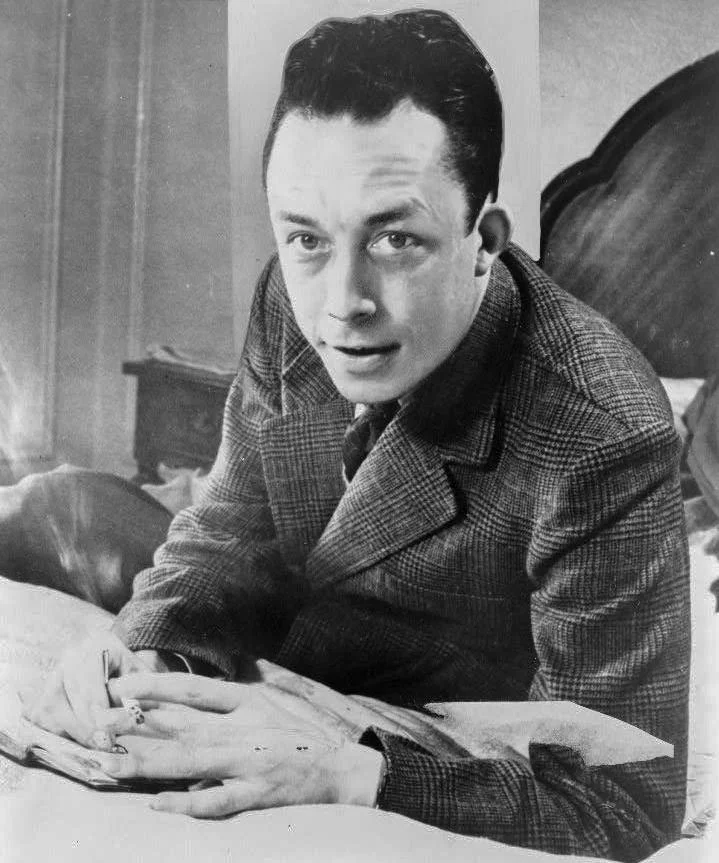
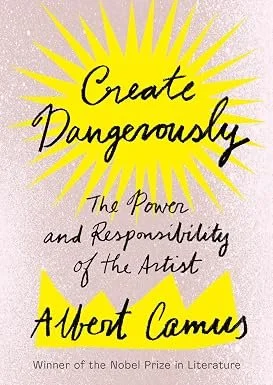
This month I decided to review the book, Create Dangerously: The Power and Responsibility of the Artist by Albert Camus. He was born into an impoverished pied-noir family in French Algeria in 1913. Pied noir is a slang term for people of French and other European descent born in Algeria.
Camus’ mother was deaf and illiterate. His father was killed in action in World War I less than a year after Camus’ birth.
Despite his family’s modest circumstances, Camus was a French citizen entitled to greater rights than Arab and Berber Algerians. These life discrepancies had a profound effect on his later life and beliefs.
Camus was an excellent student, but his grandmother expected him to quit school and become a manual laborer to help the family financially. His teacher, Louis Germain, became a friend and mentor helping him to win a scholarship to a prestigious secondary school in Algiers. When Camus won the Nobel Prize for Literature in 1957, he was only forty-four years old, the second youngest recipient of the award. During his acceptance speech, he thanked his mother and Louis Germain. Camus died in an automobile accident in 1960 at the age of forty-six.
During his life, Camus battled tuberculosis. He became an activist for human rights exposing the unfair treatment of Arabs and Berbers by French authorities. He was antifascist and worked for the French Resistance during World War II as a journalist for the banned newspaper, Combat. Though once a member of the Communist Party, Camus renounced communism and rejected Stalin. His experiences strongly affected his beliefs and writing.
As the title, Create Dangerously, indicates, Camus reflects on the power and responsibility of musicians, visual artists, and writers. He compares the importance of creativity and authenticity arguing that beauty and pain must be equally represented. He opposed the sanitization of history believing the fight for freedom of speech and expression lost meaning unless we understood the evils of censorship and oppression. It’s harder to appreciate the sacrifices of others if we don’t know the extent of their sacrifice.
He pointed out that silence is complicity and creatives should use their gifts to expose corruption and exemplify what’s most beautiful and worth saving.
Many of his assertions apply to what’s happening today. Camus identified consumer society as
“A society in which objects disappear and are replaced by symbols. When the ruling class no longer measures its wealth in acres of land or gold bars, but rather by how many digits ideally correspond to a certain number of financial transactions.”
He warns against art for art’s sake and art solely for profit insisting that creativity must be a mirror to reflect what is happening in our society.
This is an excellent short work by Camus, and I encourage you to check it out.
Selected Works by Albert Camus:
Novels:
A Happy Death (1936-38 – published posthumously in 1971)
The Stranger (1942)
The Plague (1947)
The Fall (1956)
The First Man (published posthumously in 1994)
Short Stories:
A Short Story Collection - Exile and Kingdom (1956)
Non-fiction:
Betwixt and Between (1937)
Nuptials (1938)
The Myth of Sisyphus (1942)
The Rebel (1951)
Algerian Chronicles (1958)
Resistance, Rebellion, and Death (1961)
Notebooks 1935-1942
Notebooks 1942-1951
Notebooks 1951-1959
Correspondence 1944-1959
Plays:
Caligula (1938)
The Misunderstanding (1944)
The State of Siege (1948)
The Just Assassins (1949)
Requiem for a Nun (1956) adapted from William Faulkner’s novel of the same name
The Possessed (1959) adapted from Fyodor Dostoyevsky’s novel Demons (1956)
Essays:
The Crisis of Man (1946)
Neither Victims nor Executioners (1946)
Why Spain? (1948)
Reflections on the Guillotine (1957)