




It is the morning of September 12 in the year 490 BC.
Dawn breaks over the plain of Marathon, roughly twenty-six miles northeast of Athens. Along the curving shore, hundreds of Persian ships rest against the pale waters of the Aegean. Horses stamp in the sand. Cooking fires smolder between tents. Thousands of soldiers—archers, spearmen, cavalrymen, and subject peoples drawn from across the greatest empire the world had yet known—wait beneath the gaze of their commanders.
Across the plain stands a much smaller army.
The Athenians have marched through the mountain passes to meet the invaders before they can reach their city. Beside them stand a thousand men from tiny Plataea—the only Greek city to answer their call. Sparta has promised help, but its soldiers have not arrived. For the moment, Athens stands almost alone.
The men tightening their shield straps that morning understand what defeat will mean. Only days earlier, the Persians captured Eretria, burned its temples, and carried its people away in chains. Athens can expect the same fate. Behind the hoplites lie their homes, their wives and children, their temples, and a fragile experiment in self-government scarcely two decades old. Before them stands the army of the Great King.
Between the two forces stretches nearly a mile of open ground. Soon the Athenians will have to cross it beneath a storm of Persian arrows. What we know as Western civilization hung by a thread.. . .
Greece was not a nation. It was a scattering of fiercely independent city-states spread across the mainland, the islands of the Aegean, the shores of Asia Minor, and distant colonies as far away as Spain and the Black Sea. The Greeks shared a language, gods, legends, and customs, but they were almost as likely to fight one another as to unite against a common enemy.
Athens itself was something startlingly new. Only twenty years earlier, the city had been ruled by tyrants. Now its male citizens gathered in an assembly, debated public questions, voted on laws, and elected the generals who commanded them in war. Women, slaves, and foreigners were excluded, of course, but measured against nearly every government the ancient world had known, this was radical: citizens would participate in ruling themselves.
Persia represented something entirely different. Its dominions stretched from the edges of India across Mesopotamia and Asia Minor to Egypt. Dozens of peoples, languages, and ancient kingdoms lived beneath the authority of one man: Darius, the Great King, the King of Kings. Royal messengers raced along imperial roads. Persian armies crossed continents. Its resources seemed inexhaustible.
To Darius, Athens was little more than an insolent city on the distant western fringe of civilization. But it had offended him.
Across the Aegean, Greek cities on the western coast of Asia Minor had fallen under Persian rule. In 499 BC, they revolted and appealed to their fellow Greeks for assistance. Sparta refused. But Athens and Eretria answered, sending ships and soldiers across the sea. The expedition ended disastrously, yet not before the Greeks helped capture Sardis, the seat of Persian power in the region. During the struggle, much of the city was burned.
When word reached Darius, Herodotus tells us that the Great King asked who these Athenians were. Then he called for his bow, fitted an arrow to the string, and fired it toward the heavens.
“Zeus,” he prayed, “grant me vengeance upon the Athenians.”
Darius then, to make sure he wouldn’t forget, ordered a servant to repeat three times whenever dinner was placed before him:
“Master, remember the Athenians.”
It’s a wonderfully colorful Herodotus story that almost certainly didn’t happen. But that hardly matters because Darius did, in fact, remember.
The Ionian Revolt was completely crushed by 494 BC. Cities were captured, rebels executed, and populations uprooted. Then Persia turned its attention across the Aegean. Athens and Eretria would be punished, and the free cities of Greece would be taught what happened to those who defied the King of Kings.
In 490 BC, a Persian fleet sailed west under the commanders Datis and Artaphernes. It swept through the Aegean, subduing islands along the way. Naxos was captured and burned. Those inhabitants who failed to escape into the mountains were enslaved. Sacred Delos was spared, but the message was unmistakable: Resistance meant ruin.
The fleet then descended upon Eretria. For six days, the city held. On the seventh, two prominent citizens betrayed it. Persian soldiers poured through the gates, plundered the city, burned its temples, and carried away its people.
Athens was next on the list.
The Persians landed at Marathon on a broad coastal plain well suited to an invading army. With them came Hippias, the aging former tyrant of Athens, driven into exile years earlier and now returned aboard Persian ships in the bitter hope that Darius would restore him to power. Hippias knew the land. He knew the roads leading toward Athens. He also knew that the city contained men who might prefer the return of a tyrant to the turbulence of democracy.
As news of the landing reached Athens, fear swept through the city. The Persians were not merely another Greek army arriving to settle some ancient quarrel with a hoplite battle and limited ends. Their archers had darkened skies from Egypt to India. Their cavalry had broken armies across Asia. Their king commanded more land and wealth than any Greek could easily imagine.
Athens possessed no professional standing army. Its defense depended upon ordinary citizens—farmers, craftsmen, merchants, and landowners—summoned from their homes and expected to bring their own armor and weapons. Yet these were not untrained men. Every able citizen knew that defending the city was part of belonging to it. They fought as hoplites, wearing bronze helmets and breastplates, carrying long spears and heavy round shields. When drawn together in the phalanx, each man’s shield partly protected the man beside him. The formation demanded courage, discipline, and trust. If one man fled, he endangered everyone around him.
The Athenians now faced an agonizing decision. Should they remain behind the city walls and wait for the Persians, or march out and meet them at Marathon?
Many argued for the safe choice of waiting. But one general argued forcefully for the march.
Miltiades knew the Persians better than almost any man in Athens. He had once ruled territory beneath Persian authority and had accompanied Darius’s armies during an earlier campaign. He understood how they fought—and he knew that allowing them to advance upon Athens could encourage sympathizers within the city to betray it.
His argument carried the day.
The citizen-soldiers took up their shields, embraced their families, and began the long march toward Marathon. At the same time, Athens dispatched its greatest long-distance runner to Sparta. His name was Pheidippides—also rendered Philippides—and the journey before him was staggering. Sparta lay roughly 150 miles away across mountains, ravines, and sun-scorched roads. Incredibly, he reached it the following day.
Standing before the Spartan authorities, exhausted from the run, Pheidippides delivered Athens’s plea: Do not allow the most ancient city in Greece to fall into slavery.
The Spartans were sympathetic. They possessed the most feared army in Greece and were willing to march. But they were observing the sacred festival of the Carneia and claimed that religious law prevented them from departing until the full moon. Help would come, but perhaps too late.
Pheidippides also returned with a far stranger story. While crossing Mount Parthenion on his journey, he said, the god Pan had called to him by name.
“Why,” Pan asked him, “did the Athenians neglect him when he had shown them favor and would do so again?”
To modern ears, the tale sounds impossible. But the Athenians inhabited the world of Homer, where the gods intervened constantly in human affairs—guiding heroes, striking down armies, and choosing sides in battle. To the men waiting beneath the shadow of the Persian Empire, this was not merely a comforting story. It was a sign that the powers governing the world had entered the struggle on their behalf. Pan, they believed, would unleash panic through the Persian ranks. The gods had not abandoned them.
When the Athenians reached Marathon, they encamped near a sanctuary of Heracles in the foothills overlooking the plain. There they received an unexpected sight: marching to join them were the men of Plataea. Plataea was small, but it sent everything it could—perhaps a thousand hoplites. Against the immense resources of Persia, the number may have appeared insignificant. To the Athenians, it meant they would not stand entirely alone.
They would never forget it.
For several tense days, the two armies watched each other across the plain. The Athenians waited for the Spartans. The Persians waited for division or treachery to weaken Athens. Neither side seemed eager to make the first move.
Among the ten elected Athenian generals, opinion divided. Five favored battle; five warned against risking the city’s only army against a larger force. The deciding vote belonged to Callimachus, the polemarch, or senior military magistrate. So Miltiades went to him.
The future of Athens, he argued, now rested in Callimachus’s hands. If the Athenians delayed, fear and division might spread. Men inside the city might betray it. But if they fought and prevailed, Athens could become the foremost city in Greece.
It must have been some speech. Callimachus cast his vote for battle.
Even then, Miltiades waited. Herodotus does not tell us precisely what finally moved him to attack. Perhaps the Persian cavalry was temporarily absent. Perhaps the enemy had begun loading troops onto its ships for a direct assault upon Athens. Perhaps Miltiades realized that waiting any longer risked losing the city without a fight.
Whatever the reason, the order was given. The Athenians formed their line.
Because the Persians possessed more men, Miltiades stretched his army across the plain to prevent it from being outflanked. He strengthened both wings while leaving the center dangerously thin. Callimachus commanded on the right. The Plataeans received the place of honor on the left.
Across from them, the Persians and their Saka allies held the center of the imperial line. Archers moved forward. Men raised their wicker shields. Thousands of bows waited to be drawn.
The Athenians offered their sacrifices. The omens were favorable. Miltiades gave the command. The line began to move.
At first, the Athenians advanced in formation, their spears raised above an unbroken wall of shields. Bronze armor flashed beneath the morning sun. Dust rose beneath thousands of sandaled feet.
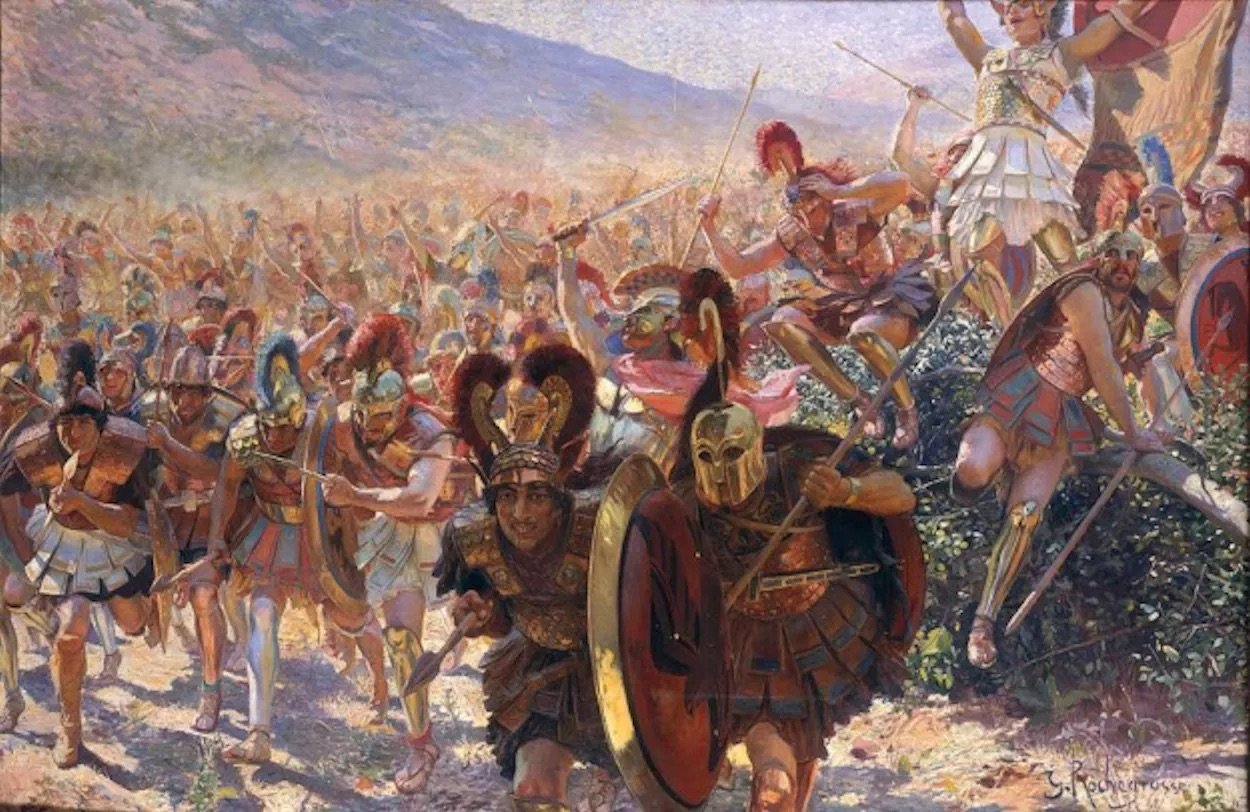
Then something extraordinary happened. The Athenians began to run.
Laden with bronze helmets, heavy shields, breastplates, and spears, hoplites were trained to advance in a tight, measured formation—not charge across an open plain. Yet for reasons historians still debate, the entire Athenian line surged forward.
To the Persians, the sight must have appeared insane. The Greeks had no cavalry. They had few archers. They were heavily outnumbered, and now they were charging across the open plain toward an army that had conquered much of the known world.
Herodotus tells us that the Persians believed madness had seized them. Then the first arrows rose into the sky.
The missiles fell with a hiss and clatter, striking helmets, shields, armor, and flesh. But the Athenians kept coming. Their formation did not break. The distance closed. Persian archers reached for another volley.
They did not have enough time.
The Athenian phalanx crashed into the Persian line with the splintering of wood and the grinding of bronze. Spears drove through wicker shields and into flesh. Men fell beneath the crush. The broad plain dissolved into screams, dust, blood, and confusion.
In the center, where Miltiades had deliberately thinned his formation, the Persians and Saka pressed forward. The Athenian line bent beneath their weight and began to give ground. But on the wings, the heavier Greek infantry broke through.
The Athenians and Plataeans could have pursued the fleeing men before them. Instead, they wheeled inward and fell upon both sides of the Persian center. The conquerors now found themselves pressed from three directions.
The line collapsed.
Persian soldiers turned and ran for the sea. Some stumbled into the marshes and drowned. Others raced across the sand toward the ships as the Greeks pursued them into the surf.
The fighting did not end at the water. Men grappled around the hulls. Greeks tried to seize the vessels while Persian crews fought desperately to push away from shore. Callimachus fell near the ships. Cynaegirus, brother of the playwright Aeschylus, reportedly seized the stern of a Persian vessel with his bare hand and held on until an enemy axe severed it.
The Persians finally escaped, but they left seven ships and thousands of dead behind them.
Against all expectation, Athens had won the battle.
But there was no time to celebrate. From the shore, the Athenians watched the surviving Persian ships turn south. Rather than sailing home, the fleet began moving around the Attic coast.
Its destination was Athens.
The Persian commanders hoped to reach the undefended city before its exhausted army could return. Perhaps men within Athens were prepared to open the gates. According to Herodotus, someone raised a polished shield as a signal to the fleet, though who gave it and what it meant remain uncertain.
The same men who had marched from Athens, waited for days beneath the sun, charged through a storm of arrows, fought a savage battle, and driven the Persians into the sea now had to race back to their city. They left a portion of there army to guard the battlefield and began the grueling march.
Their armor weighed heavily upon their shoulders. Blood had dried on their tunics. Their feet were bruised, and many carried wounds that had not yet been bound. Still they forced themselves through the mountain passes and along the dusty roads, marching roughly twenty-six miles back home.
The Persian fleet had the longer journey around Cape Sounion. The Athenians had the shorter road, but they had to cross it on exhausted legs.
They reached the city first.
When the Persian ships finally appeared offshore near Phaleron, the invaders saw the men they had just fought standing once more in battle formation between them and Athens. After lingering offshore, the fleet turned east and sailed back toward Asia.
Athens was safe.
Herodotus records that 6,400 Persians lay dead at Marathon. The Athenians lost 192 men, along with a smaller number of Plataeans. Ancient casualty figures must always be treated cautiously, but the imbalance testified to the completeness of the victory.
The fallen Athenians received an extraordinary honor. Rather than returning their bodies to the family tombs of Athens, the city buried them together upon the battlefield where they had fallen. A great mound was raised above them, one that remains visible on the plain of Marathon today.
. . .
The victory did not destroy the Persian Empire, of course. Darius still ruled lands and commanded armies beyond anything Athens could match, and he immediately began preparing another invasion. However, he would not live to lead it. Ten years later, his son Xerxes crossed into Greece at the head of a force far greater than the one the Athenians had faced at Marathon. But this time, Athens would not stand alone. The Spartans and other Greek cities joined the fight. At Thermopylae, a small Greek army led by the Spartan king Leonidas made its legendary stand; at Salamis, the Athenian fleet shattered Persian power at sea; and at Plataea, a united Greek army finally broke the invasion on land. Against overwhelming odds, the Greeks would do it again.
But without Marathon, they would have already lost. Athens would have been crushed.
The battle also gave the young Athenian democracy something no lawgiver could have bestowed: confidence. The men who voted in the assembly had fought shoulder to shoulder in the phalanx. They had made a collective decision to resist, and then they had borne its terrible cost together.
In the decades that followed, Athens would produce Aeschylus, Sophocles, Euripides, Socrates, Plato, Thucydides, and build the Parthenon. Its democracy would remain deeply imperfect, and Athens itself would become arrogant and imperial. But the civilization that emerged there would help shape philosophy, drama, history, political thought, art, and the very basis of Western civilization.
None of that future was visible to the exhausted men standing before Athens as the Persian fleet disappeared over the horizon. They knew only that their homes remained standing. Their families were free.
And on September 12, 490 BC, when the greatest empire on earth came to punish their city, the citizens of Athens had not waited behind their walls.
They had run toward the enemy.
*Artwork: The Heroes of Marathon, Georges-Antoine Rochegrosse, 1911. Musée des Beaux-Arts de Nîmes. Public domain.

Tony Valerino is an author and independent researcher focused on American history and Western civilization. He has published two books, his most recent a history of the United States told through turning points that shaped the nation’s people and institutions. He also writes daily historical essays and reflections on his blog. Links below.
Pivotal Moments That Shaped America - https://a.co/d/g6qjSrw
Facebook blog - https://www.facebook.com/share/1FNLF42a8K/?mibextid=wwXIfr
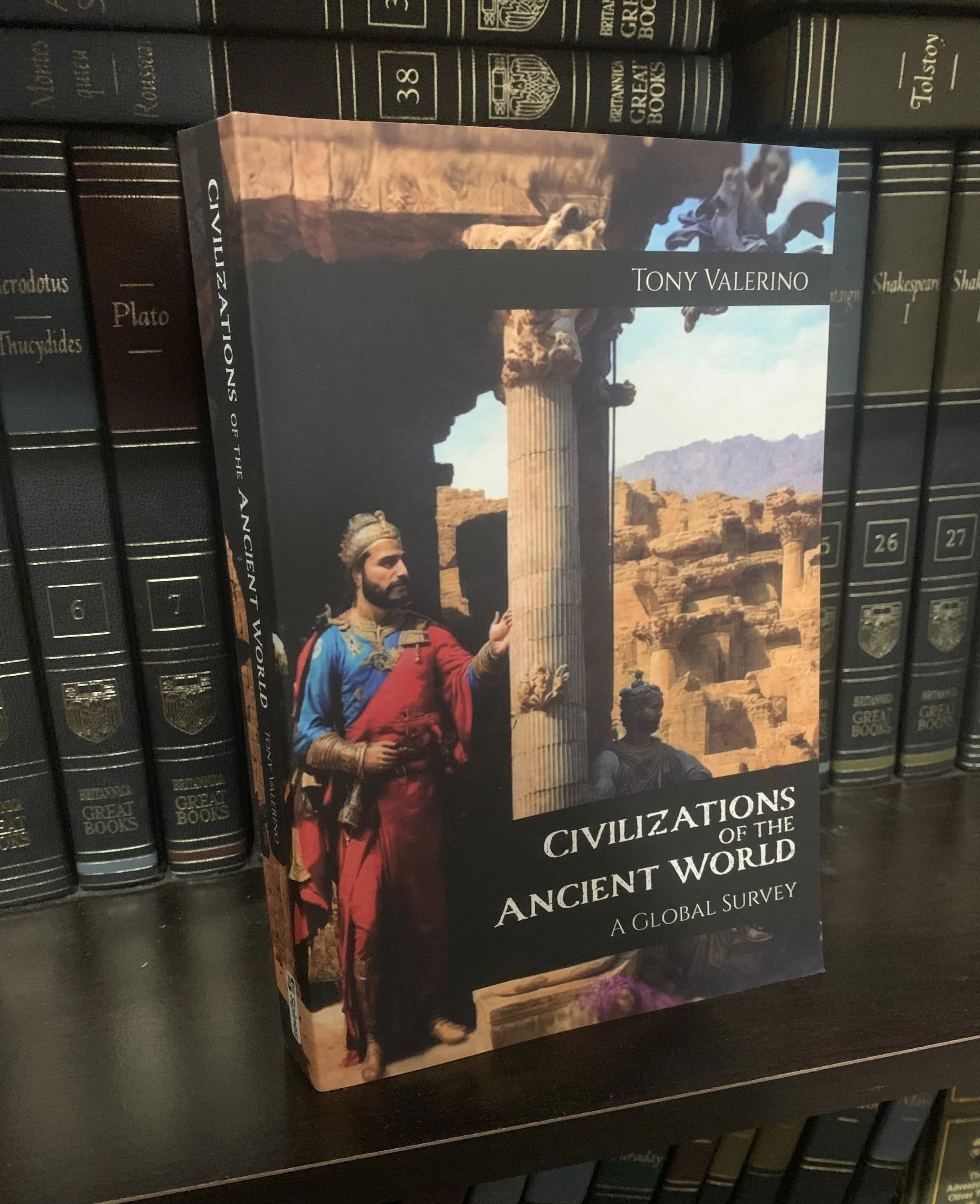
Civilizations of the Ancient World - https://a.co/d/e65mKDD