





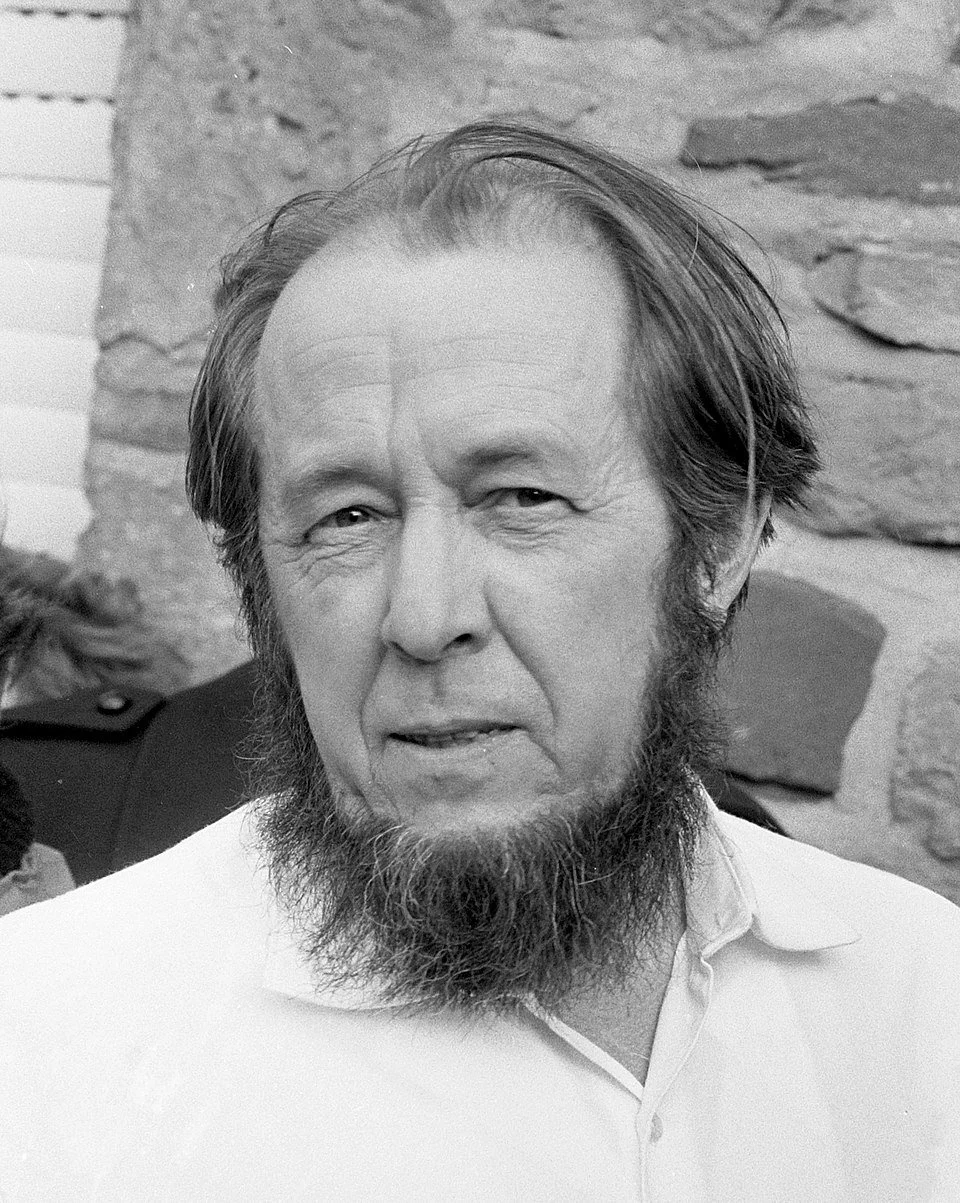
Aleksandr Solzhenitsyn (December 11, 1918- August 3, 2008) was a Soviet and Russian writer and dissident. He helped raise global awareness of the political repression in the Soviet Union, and exposed the harsh conditions in the Gulag prison system.
He was born in Kislovodsk, Russia and died in Moscow at the age of 89. His father was of Russian descent, and his mother was of Ukrainian descent. His father rose from humble beginnings to become a wealthy landowner before the Russian revolution in 1917.
He died in a hunting accident before Aleksandr was born. Solzhenitsyn was raised by his mother and his aunt. Their property had been seized and turned into collective farms, so the family was no longer wealthy. They remained members of the Russian Orthodox Church in defiance of the Soviet anti-religion campaign of the 1920s. As a young man, Solzhenitsyn lost his faith in the church and fully embraced atheism and Marxism-Leninism.
He served as a captain the Red Army during World War II, before being arrested by SMERSH (the umbrella organization created by Josef Stalin for three Russian counter-intelligence agencies). One of its purposes was to root out anti-Soviet elements in the Red Army. Solzhenitsyn, a twice decorated officer and recipient of the Order of the Red Star, was charged and found guilty of calling for the overthrow of the Soviet regime in private correspondence with another field officer. For this alleged infraction, he was sentenced to eight years in the Gulag and then internal exile.
During his imprisonment, Solzhenitsyn turned to philosophy and became an Eastern Orthodox Christian. Until his imprisonment and time in the camps, Solzhenitsyn had never questioned the state ideology or the superiority of the Soviet Union. After witnessing horrific acts of brutality by his fellow soldiers and what he believed were the failings of Josef Stalin, Solzhenitsyn supported the idea of overthrowing the Stalin regime.
Under Khrushchev’s regime, he was released and exonerated. After his release Solzhenitsyn began speaking and writing about his experiences. His novels exposed the repression in the Soviet Union under Josef Stalin. In 1962, during what historian’s call the Khrushchev Thaw his first novel, One Day in the Life of Ivan Denisovich, an account of Stalinist repressions, was written with Khrushchev’s approval. His third novel, Matryona’s Place in 1963 was his last work published in the Soviet Union. After the Khrushchev regime ended, Soviet authorities no longer wanted Solzhenitsyn to continue writing.
He persisted and his works were published in other countries. He penned Cancer Ward (1966), In the First Circle (1968), August 1914 (1971), and the Gulag Archipelago (1973). His 1970 written lecture, “Laureate lecture” was awarded a Nobel Prize.
The Gulag Archipelago so enraged Soviet officials that they stripped Solzhenitsyn of his Soviet citizenship and deported him to West Germany. After moving to Switzerland, he eventually relocated with his family to Vermont in the United States. His Soviet citizenship was restored in 1990, but he continued to live and work in Vermont until 1994 when he returned to Russia. He remained in Russia until his death in 2008.
During his lifetime, Solzhenitsyn remained a controversial figure. He supported the Vietnam War, but objected to the wars in Iraq and Afghanistan. He was often accused of antisemitism, and he supported Vladimir Putin’s regime though he did criticize the oligarchic excesses of the new Russian democracy. He was also critical of Soviet society for not protecting basic human rights and the rule of law and NATO and the U.S. policies toward Russia which he felt were too legalistic and limiting.
He did not support Ukrainian independence believing that a united Slavic state encompassing Russia, Ukraine, and Belarus built on Orthodox foundations would provide an ideological alternative to western individualistic liberalism. He also did not support women being ordained as priests. He became more conservative as he got older.
Selected Works by Aleksandr Solzhenitsyn:
Novellas:
One Day in the Life of Ivan Denisovich (1962)
An Incident at Krechetovka Station (1963)
Matroyna’s Place (1963)
For the Good of the Cause (1963)
Novels:
The First Circle (1968)
Cancer Ward (1968)
August 1914 (historical novel – 1971)
The Gulag Archipelago (3 volumes written from 1973-1978)
Miscellaneous:
The Love-Girl and the Innocent (1969 – play)
“Laureate lecture” (1970 – written lecture)
Prussian Nights (written 1951/published 1974 -selected poems)
Letter to the Soviet Leaders (1975)
Solzhenitsyn: The Voice of Freedom (1975 – selected speeches)
Warning to the West (1976 – 5 speeches given in the U.S. (3) and the U.K. (2) )
The Moral Danger: Misconceptions about Soviet Russia and the Threat to America (1980 – letters)
Photo Credit:
By Bert Verhoeff for Anefo - [1] Dutch National Archives, The Hague, Fotocollectie Algemeen Nederlands Persbureau (ANEFO), 1945-1989, Nummer toegang 2.24.01.05 Bestanddeelnummer 927-0019, CC0, https://commons.wikimedia.org/w/index.php?curid=29177274