





Dare to Believe is back this month with two exceptional Native Americans, Zitkala-Ša and Chief Joseph. These individuals tried to work within a corrupt U.S. system promoting American exceptionalism and westward expansion to achieve peaceful outcomes that would benefit their people and preserve their heritage.
Zitkala-Ša, one of the most influential Native Americans of the 20th century, was the co-founder of the National Council of American Indians. This organization lobbied for Native People’s right to U.S. citizenship.
Chief Joseph attempted peaceful negotiations with the U.S. federal government to protect his people and their lands. When the Wallowa were forcibly removed from their home in northeastern Oregon, he joined with other Native American chiefs in a courageous attempt to reach Canada and freedom.
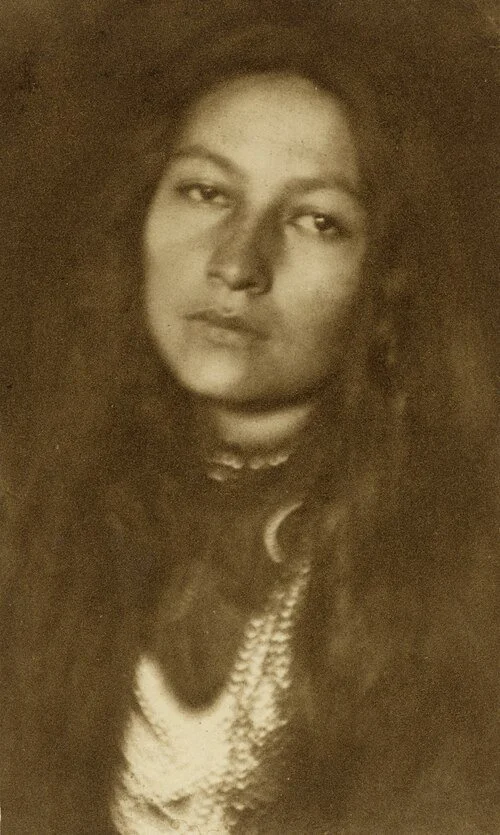
Zitkala-Ša (1876-1938) was a Yankton Dakota educator, writer, and political activist. She was also known as Gertrude Simmons Bonnin, her anglicized and married name.
She was born on the Yankton Indian Reservation in South Dakota.
When she was a small child, her French father abandoned the family, so she was raised by her mother, Thaté Iyóhiwiŋ.
During the first eight years of her life Zitkala-Ša lived with her mother on the reservation where she learned the Dakota language. When white missionaries came to the reservation, they recruited several Yankton children to attend a Quaker Missionary school in Wabash, Indiana. Zitkala-Ša was an excellent student who enjoyed reading, writing, and playing the violin, but during her three years at the school, she was forced to cut her long hair, pray as a Quaker, and abandon her native language and customs.
When she returned to the reservation, she was dismayed by the changes she saw. Zitkala-Ša longed to resume Yankton traditions, but she felt trapped between two worlds. Many on the reservation had embraced white culture.
In 1891, Zitkala-Ša returned to the White’s Indiana Manual Labor Institute in order to further her education. Though the school expected its female students to become housekeepers in white households, she wanted more. Zitkala-Ša studied piano and violin and began teaching music at the school after the music teacher resigned.
At her graduation, she delivered a powerful speech about women’s right.
Zitkala-Ša received a scholarship to Earlham College in Indiana. While at Earlham, she felt isolated being one of only a few non-white students. She compensated by translating a collection of traditional Native stories from various Native tribe into Latin and English for children to read. Six weeks before graduation, ill health and financial difficulties forced her to leave school in 1897.
For the next year, she played the violin and studies at the New England Conservatory of Music in Boston while teaching music to children at the Carlisle Indian School in Pennsylvania. She also raised issues about the treatment of Native Americans.
In 1900, Zitkala-Ša began writing articles on Native American life for national magazines such as Harper’s Monthly and Atlantic Monthly. Many of her articles explored the shortcomings of the American Indian boarding school system and the forced displacement of Native American tribes and indigenous peoples.
In 1901, Carlisle’s founder, Colonel Richard Henry Pratt, sent Zitkala-Ša back to the Yankton Reservation to recruit students. It was her first trip back in many years. She was shocked to find many homes in disrepair and members of her family living in poverty. There were also white settlers living on land specifically designated for Yankton Dakota under the 1887 Dawes Act.
When she returned to the school, Zitkala-Ša began questioning Pratt’s methods of forced assimilation into white culture. She also complained about the limited curriculum which only prepared students for manual labor jobs in rural areas.
After she published “The Soft-Hearted Sioux,” an article for Harper’s Monthly describing loss of identity felt by a Native American boy after his force assimilation at the Carlisle school, Pratt was furious. He denigrated her work and fired her. At the time, she was engaged to Carlos Montezuma, a Yavapi doctor and indigenous activist. When he refused to leave his medical practice in Chicago to move to the Yankton Reservation with her, she ended the engagement.
The following year, she met and married Raymond Talephause Bonnin, who was of Yankton and European ancestry. The Bureau of Indian Affair (BIA) sent Bonnin to work at the Uintah-Ouray reservation in Utah. Zitkala-Ša and her husband lived and worked with the Ute people for fourteen years. Their only child, Raymond Ohiya Bonnin was born during that time. While living on the Uintah-Ouray reservation, she met and American composer and collaborate on the music for the Sun Dance Opera. In 1938, the New York Light Opera Guild selected The Sun Dance Opera and presented it at The Broadway Theatre as its opera of the year.
In 1917, Bonnin enlisted in the U.S. Army after the U.S. declared war on Germany. In 1920, he was discharged with the rank of Captain.
From 1916 to 1924, she began writing and publishing political works and the Bonnins moved to Washington D.C. She co-authored several important works about the lives and challenges of Native Americans. Zitkala-Ša also created the Indian Welfare Committee of the General Federation of Women’s Clubs and acted as one of its researchers for most of the 1920s.
She was an active member of the Society of American Indians. The organization published American Indian Magazine. She contributed articles and served as editor from 1918 to 1919 calling for recognition of Native American cultures and traditions. Zitkala-Ša also advocated for U.S, citizenship for all Native Americans which would allow them to participate fully in mainstream America to gain political power and protect their cultures. In 1924, American Indians were granted the right to vote, but several states blocked the rights of Native Americans to vote until the Civil Rights movement during the 1960s.
Zitkala-Ša helped trigger a federal investigation into the exploitation of Native Americans in Oklahoma and attempts to defraud them of drilling rights and leasing fees for their oil rich lands. During a national speaking tour, she advocated for the abolition of the BIA because of serious corruption within the bureau.
In 1926, Zitkala-Ša and her husband founded the national Council of American Indians (NCAI) and dedicated their lives to the cause of uniting U.S. native tribes to further the cause of gaining full citizenship rights through suffrage. Zitkala-Ša served as president, major fundraiser, and speaker for the NCAI advocating for civil rights, better access to education and healthcare for all native Americans until her death in 1938.
She is buried beside her husband at Arlington National Cemetery.
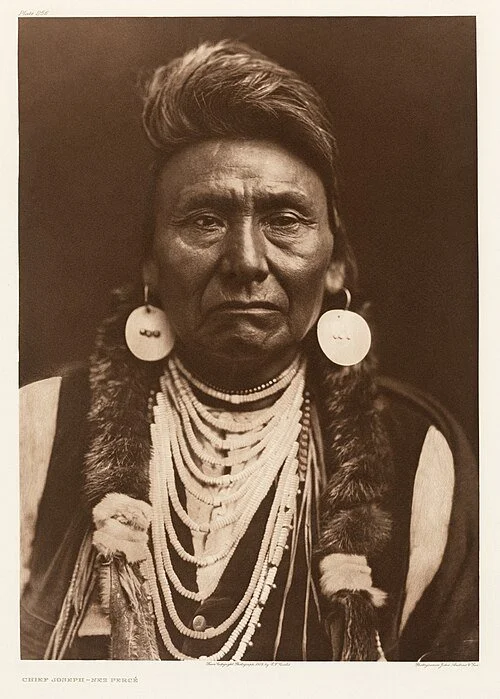
During the mid to late 1800s. Chief Joseph, Hinmatóowyalahtqit (Pronounced Hin-mah-too-yah-lat-kekt), (1840-1904), was the leader of the Wallowa band of Nez Perce, a Native American tribe of the interior Pacific Northwest region of the U.S. He was known as Joseph the Younger until 1871, when he became tribal leader after the death of his father, Joseph the Elder (Tuekakas).
Joseph the Elder grew wary of the white settlers he had originally welcomed to the Wallowa Valley when they continued to demand more land for farming and raising livestock. Isaac Stevens, the governor of the Washington Territory, took it upon himself to assemble a committee charged with designating separate areas for natives and settlers.
In 1855, Joseph the Elder signed the Treaty of Walla Walla with the United States government which established a 7,700,000-acre Nez Perce reservation that included Joseph’s Wallowa Valley, in present-day Oregon, Idaho, and Washington. He entrusted Young Joseph with protecting their 7.7-million-acre homeland which included his ancestor’s burial places.
In 1863, the gold rush attracted an influx of white settlers, and the government formed a new council which decided the Nez Perce should surrender all but 760,000 acres of their 7.7-million-acre reservation. The smaller acreage was situated around Lapwai village in the Idaho territory and did not include Wallowa Valley. The government promised financial rewards, a hospital, and schools for the reservation.
Joseph the Elder and several other chiefs refused to sign the treaty. Chief Lawyer, the leader of the Niimíipu Nez Perce, and one of his allies agreed to sign on behalf of the Nez Perce Nation. This divided the leaders of the Nez Perce Nation. Some bands moved to the smaller reservation and others remained in or near the Wallowa Valley. The elder Joseph condemned the United States for its treachery and refused to leave Nez Perce land in the Wallowa Valley. He marked Wallowa land with a series of poles creating a border between the Wallowa and outsiders.
Before his death, Joseph the Elder advised his son to refuse to sign treaties with the federal government that would cede Nez Perce territory. “Never sell the bones of your father and your mother,” he admonished.
The Wallowa’s refusal to sign the 1863 treaty was met with hostility and cruelty by white settlers and the federal government. In spite of this, Chief Joseph did not allow his people to retaliate with violence.
In 1873, Joseph agreed to negotiate with the federal government to protect his people’s home in the Wallowa Valley. In 1877, the federal government reneged on their promises and Army General Oliver O. Howard threatened to attack unless the Wallowa band agreed to relocate to the Idaho reservation. Joseph tried to negotiate with Howard, but the general became angry when Joseph questioned if the Great Sprit Chief (aka God to Christians) “would give one kind of men the right to tell another kind of men what they must do.”
Joseph and other chieftains agreed to travel to the Idaho reservation to examine potential sites for a Wallowa settlement. Howard showed them a parcel of land occupied by a spattering of white settlers and other bands of Nez Perce. He offered to have these people removed, but Joseph and his chieftains refused to take lands that did not belong to them.
Howard informed Joseph that he and his people had thirty days to leave the Wallowa Valley and accept the reservation land, or their continued presence would be considered an act of war.
Chief Joseph continued to advocate for peace, but other chieftains retaliated with violence leading to the Nez Perce War.
As the violence escalated, he and other non-treaty Nez Perce chiefs began moving their people to the Idaho reservation. The U.S. Army followed them intent on retaliation. Joseph banded with other nations on the reservation and attempted to lead their people to safety across the Canadian border.
Faced with freezing temperatures, no food or blankets, and a dwindling supply of weapons, Joseph and the other chiefs were forced to surrender just sort of the border. After Joseph negotiated with Generals Miles and Howard for a surrender that would allow his remaining people a safe return to their home on the reservation, General Sherman overruled their decision and forced Joseph and 400 of his people to be transported in unheated railway cars to Fort Leavenworth, Kansas where they were confined to a prisoner of war camp for eight months. In the late summer, they were taken by railway cars to a reservation in the Indian territory, now known as Oklahoma, where most of them died from epidemic diseases.
In 1879, Chief Joseph went to Washington D.C. to plead his people’s case to President Hayes. Joseph and his people simply wanted to be allowed to return to the reservation in Idaho. The government of Idaho was opposed to the Nez Perce being allowed to return because of bitterness about the Nez Perce War.
In 1885, Joseph and his people were supposed to be allowed to return to the Pacific Northwest to settle on the reservation around Kooskia, Idaho. Instead, they were taken to the Colville Indian Reservation which was home to eleven tribes unrelated to the Nez Perce. It was far from their home in the Wallowa Valley and the rest of their people on Idaho reservations. Other Nations resented ceding territory to the Wallowa creating tensions on the reservation.
Chief Joseph continued his efforts to bring his people back to their home in the Wallowa Valley. A year before his death, he met with President Theodore Roosevelt in his final attempt to return his people to the land of their ancestors. His pleas were ignored. In 1904 he died of what his doctor described as a broken heart. Chief Joseph was buried near Nespelem, Washington, where many ancestors of his tribe still live.
Famous quote by Chief Joseph, “It does not require many words to speak the truth.”