




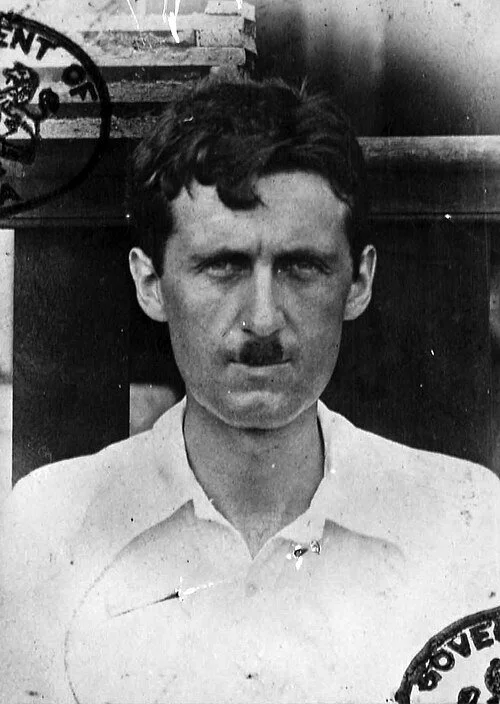
Eric Arthur Blair aka George Orwell (25 June 1903 – 12 January 1950) was born in British India (modern-day Bihar, a state in eastern India). His father, Richard worked as a Sub-Deputy Opium Agent in the Indian Civil Service. His mother, Ida had a French father. She moved back to England with Eric when he was one.
Blair attended Eton College and worked as a police officer in Burma (now Myanmar) after his graduation.
During his time as a police officer, he noticed the discrepancies between his privileged life and the poverty of the locals. He felt their anger and resentment of these inequalities. Sometimes their attitudes angered him. At other times, he understood and recognized his own privilege. It was a drastic change from his life in England where he was only able to attend Eaton because he earned a scholarship. His parents had social standing, but not wealth.
On his days off, Blair began traveling to impoverished areas in disguise and using an assumed name to experience poverty and class biases firsthand. He favored the name P.S. Burton.
Blair returned to England in 1927 hoping to become a writer. His family name and Eton education offered certain advantages he was loathe to accept. To escape from his class background, he took manual jobs in hotel kitchens in Paris and lived as a tramp in London under assumed names.
His experiences became fodder for his first book, Down and Out in Paris and London. It was published in 1933 under a pen name because Blair worried his parents might be embarrassed by its contents. According to his sister, their parents were more surprised than embarrassed. They felt as if the author and their son must be different people.
Blair used several pseudonyms. Some were for tramping, and he felt these names weren’t suited to appear on book jackets. He narrowed his pen name to three choices, Kenneth Miles, George Orwell, and H. Lewis Always. Blair pitched George Orwell to his publisher who readily agreed.
Some critics have theorized that Blair became Orwell in a deliberate and life changing transformation. Most critics argue that George Orwell was nothing more than a pen name. He answered to both names, but remained Eric to his friends, family, and acquaintances. Legally he remained Eric Blair, received royalties, bought property, and married under that name. Others theorize that George Orwell may have been an idealized persona of the man Blair always wanted to be. As George, he could be a bastion of truth, a plain-speaking man of unquestionable integrity, honesty, and conviction.
For several years, Blair wrote and published articles and reviews under both names (Eric Blair and George Orwell).
Blair was a contradiction. He was quiet and introverted, but always extremely polite. He was an intellectual, but loved pranks and practical jokes. He was gentle, but once he severely beat a student for an infraction. He was homophobic but openly befriended LGTBQ individuals. He was an atheist, but he had read the Bible extensively and quoted passages from memory. He was married in a religious ceremony. His final wishes included an Anglican funeral and burial in an Anglican cemetery.
In the early 1930s, Blair was the headmaster of two small private boy’s schools in the London area to support himself while he was writing. Eventually, he was able to support himself and his family by working as a journalist and reviewing books while he worked on novels.
In 1936 he married Eileen O’Shaughnessy. When the Spanish Civil War broke out that same year, Blair traveled to Spain as a journalist but quickly volunteered to fight against the Nationalist forces under General Franco. The war convinced him that authoritarianism and communism were bad and solidified his support of democratic socialism. While recovering from a gunshot wound to the throat in a Spanish hospital, Blair was probably exposed to and contracted tuberculosis.
In 1944, he and his wife adopted a three-week old baby boy. They named him Richard, and Blair was a devoted and loving father. In 1945, Eileen died and he became a single parent. Blair missed his wife and the closeness and companionship of marriage. He also believed Richard needed a mother.
He proposed to four women and Sonia Brownell eventually accepted. They were married for three months before he died in 1950 at the age of 46. Many critics believe Sonia was the model for the character Julia in Nineteen Eighty-Four.
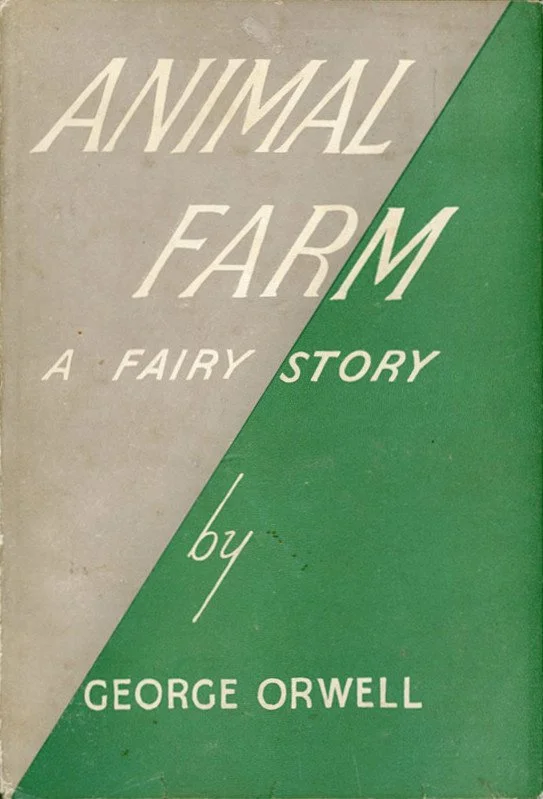
Animal Farm, one of his best-known works was an allegorical novella about mistreated animals who overthrow their human farmer and attempt to create a utopian society. Napoleon a Berkshire boar eventually seizes power and becomes a dictator worse than his human oppressor. The story is a biting satire of the aftermath of the 1917 Russian Revolution and Napoleon is Josef Stalin.
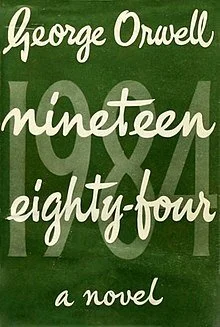
His novel, Nineteen Eighty-Four, was written in Scotland between 1947 and 1948 while Blair was recovering from a bout of tuberculosis. It explores the dangers of totalitarian governments, mass surveillance, and misinformation. Nineteen Eighty-Four is widely considered one of the most important books of the twentieth century. In 2019, the BBC included it on their list of the 100 most influential novels.
George Orwell is considered the father of modern dystopian fiction although he was not its creator. That distinction belongs to Yevgeny Zamyatin and Aldous Huxley. Orwell’s work systematized and introduced the concepts and iconic language of state control and surveillance. In Nineteen Eighty-four, he created a fictional controlled vocabulary known as Newspeak including words such as doublethink, Big Brother, thoughtcrime, unperson, memory hole, doubleplusgood, bellyfeel, and crimethink.
His non-fiction works often focused on economic and social injustices and support for working class people. He supported anti-fascism, anti-Stalinism, anarchism, and democratic socialism.
His works still appear on lists of banned or challenged books.
He died of a massive lung hemorrhage caused by tuberculosis and aggravated by a lifetime of heavy smoking.
"If large numbers of people believe in freedom of speech, there will be freedom of speech, even if the law forbids it. But if public opinion is sluggish, inconvenient minorities will be persecuted, even if laws exist to protect them." George Orwell
Works by George Orwell:
Novels:
Burmese Days (1934)
A Clergyman's Daughter (1935)
Keep the Aspidistra Flying (1936)
Coming Up for Air (1939)
Animal Farm (1945)
Nineteen Eighty-Four (1949)
Nonfiction:
Down and Out in Paris and London (1933)
The Road to Wigan Pier (1937)
Homage to Catalonia (1938)
Source: https://blog.nls.uk/eric-blair-becomes-george-orwell/