





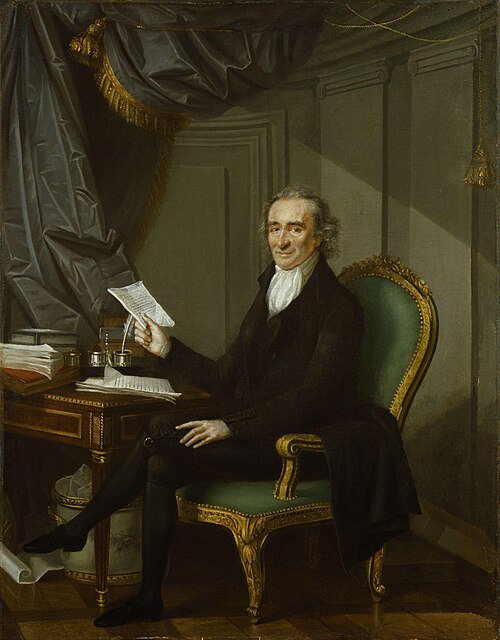
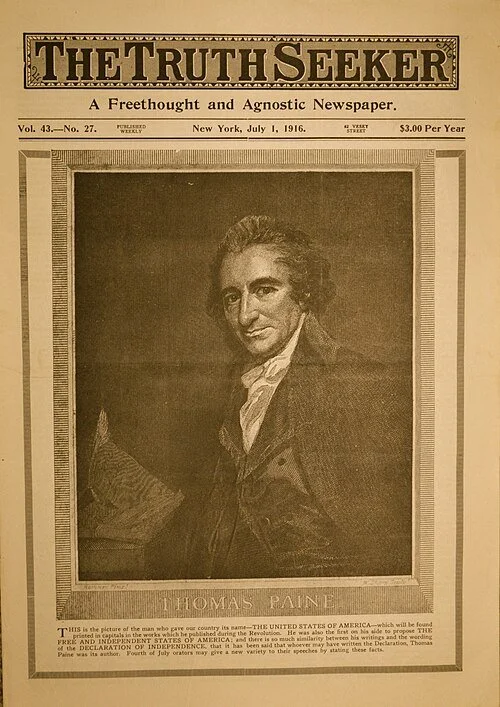
Thomas Paine (February 9, 1737 – June 8, 1809) was an English-born American Founding Father, political philosopher, statesman, and inventor. With the help of Benjamin Franklin, Paine immigrated to the British American colonies in 1774 shortly before the Battles of Lexington and Concord. He quickly became involved in the Philadelphia newspaper business.
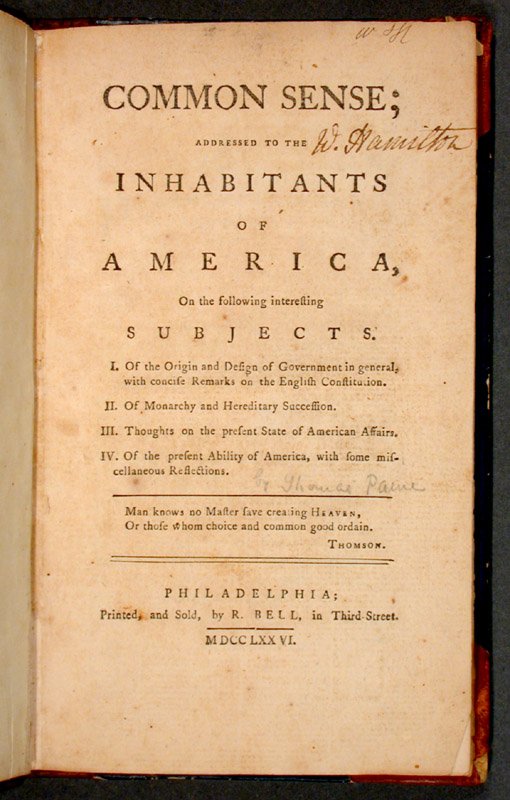
His 47-page pamphlet, Common Sense, motivated American patriots and common men to call for independence from Great Britain. It was the first book calling for full-fledged independence. Using clear and precise language, Paine listed the moral and political arguments for fighting to over through British rule and form an egalitarian government.
Published anonymously in Philadelphia on January 10, 1776, at the beginning of the American Revolution, Common Sense struck a chord with the colonists. It was widely distributed and read aloud at taverns and meeting halls. In 1776, it had the largest sale and circulation of any book published in American history. It’s still in print and remains the all-time best-selling American title.
Common Sense began as a series of letters meant to be published in Philadelphia newspapers. Because of the growing length of his project, Paine determined his writings would be more effective in pamphlet form.
Some of Paine’s most famous quotes from Commone Sense:
“From the error of other nations, let us learn wisdom.”
“The cause of America is in great measure the cause of all mankind.”
“Such is the irresistible nature of truth that all it asks, and all it wants, is the liberty of appearing.”
“The more men have to lose, the less willing are they to venture.”
From 1776-1783, Paine wrote a series of sixteen pamphlets called The American Crisis. The purpose of the pamphlets was to inspire colonists to keep fighting and never give in to despair. Once again, Paine used language easy understood by common men and avoided lofty platitudes. The pamphlets bolstered American morale and informed the British public about the issues at stake in the war.
The first volume begins with the famous words, “These are the times that try men’s souls.”
Other famous quotes:
“Where information is withheld, ignorance becomes a reasonable excuse.”
“‘The times that tried men’s souls,’ are over and the greatest and completest revolution the world ever knew is gloriously and happily accomplished.”
Paine returned to England in 1787 and wrote Rights of Men in 1791 in response to critics of the French Revolution. The British government of William Pitt the Younger feared the possibility of an English revolt, so it began repressing works espousing radical philosophies. Paine’s work advocated the right of the people to overthrow their government. His written words led to a trial and a conviction in absentia in England in 1792 for seditious libel. Luckily, Paine fled to France before he could be arrested.
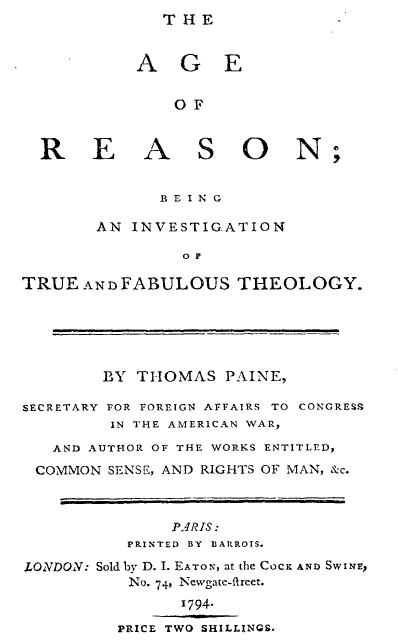
Paine was elected to the French National Convention and became caught between rival political factions. While writing The Age of Reason, he was arrested and taken to Luxembourg Prison in Paris. The new American Ambassador to France, James Monroe, used his political connections to have Paine released from prison in 1794.
Famous quotes from The Age of Reason:
“One good schoolmaster is of more use than a hundred priests.”
“It is necessary for the happiness of man that he be mentally faithful to himself.”
“Whether we sleep or wake, the vast machinery of the universe still goes on.”