

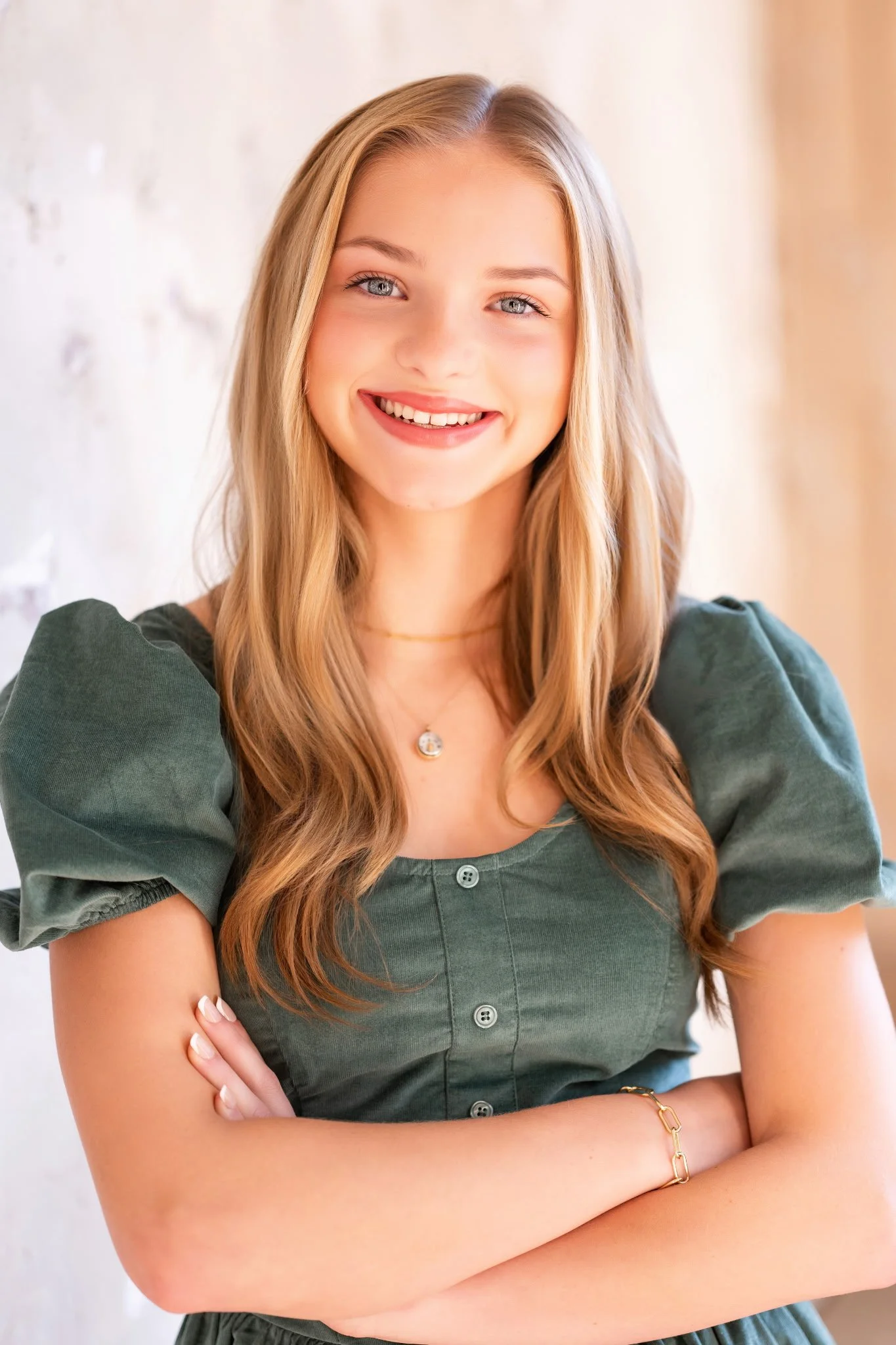
This month, we are pleased to feature a Q&A with a young up and coming writer in the fantasy genre, Berkley June Hutson.
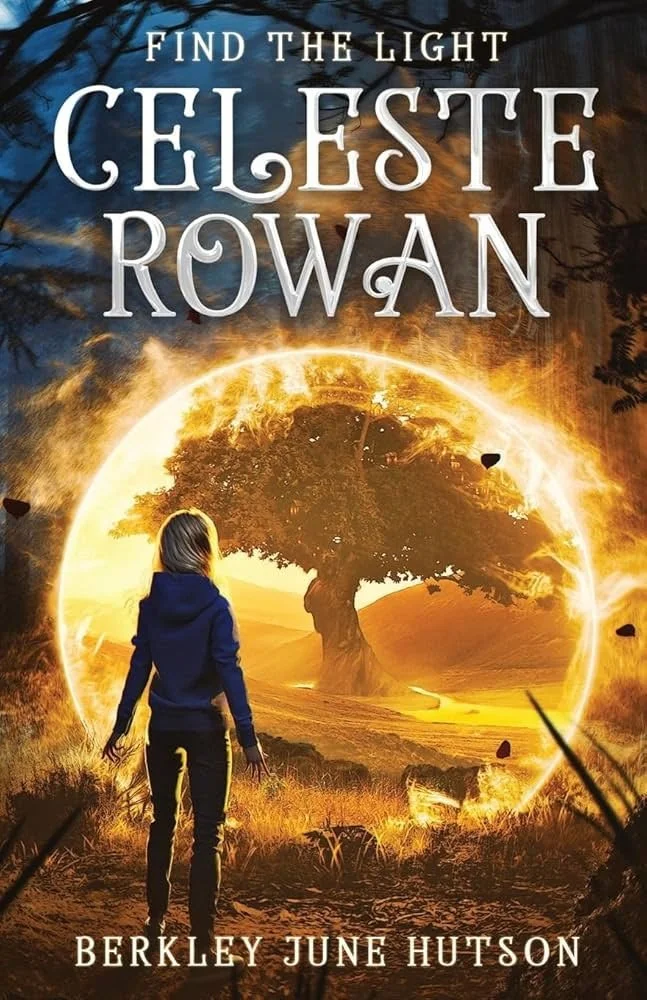
Berkley is the author of Celeste Rowan: Find the Light, a fantasy for ages 8-18. It’s suitable for middle grade readers, young adults, and adults who enjoy fantasies featuring cozy romantic or high stakes plot driven stories.
Berkley is a fourteen-year-old middle school student in Alabama. She started working on her novel in sixth grade, and recently self-published her work.
Penning a novel is an enormous task. Countless adults begin but never finish. Would-be writers of all ages have first efforts they’ve abandoned tucked away in a box or languishing under a file name on their computers. Some have a collection of rejection letters from publishers and literary agents. Others have the courage to attempt self-publishing, but few follow through by creating a website and promoting their work.
Luckily for us, Berkley is one of the few.
After I read her novel, I was impressed by the strength of the plot and Berkley’s ability to develop her characters. Reading about fourteen-year-old characters who sound and act like fourteen-year-olds is refreshing. Seeing them rise to the occasion during a “high stakes” battle to save the world is priceless.
Berkley delivered an entertaining story complete with romance, betrayal, and an epic battle between good and evil.
I was curious to learn about her motivation for penning the story and what’s next. After contacting her through a trusted adult, I’m delighted to present Berkley June Hutson’s answers to my questions in her own words.
Thank you, Berkley!
1. Most writers are ardent readers. Do your parents stress the importance of reading? Did they read to you often? What were some of your favorite bedtime stories?
My parents never had to stress the importance of reading to me because from the time I learned to sound out words on a page I was digging into books. Growing up, my parents would often read children's books to me, and to this day those are some of my favorite memories. My favorite books were Belly Button Book, Stellaluna, and Forever And Always.
2. Do you have a favorite genre? Who are your favorite authors? Why?
My favorite genre is middle grade or YA fantasy, and some of my favorite authors in that genre are Shannon Messenger and Rick Riordan. I love that they told stories that proved to young kids that we don’t have to always fit in, and that being unique is one of the best things to be. That is one of my primary focuses in my book. I love highlighting the fact that differences are kind of like superpowers. They allow us to shine, just like Celeste Rowan does.
3. How old were you when you decided you wanted to become a writer? What influenced your decision?
I didn’t really decide that I wanted to be an author until about halfway into writing my book when I was thirteen. At first, it was just a random story I needed to write down, but then it turned into something I loved. That love, or passion for writing is what influenced me to pursue it further long term. Writing became a creative outlet, and it was almost therapeutic. I got to sit there and type up stories that in many ways represented how I was feeling at that time. It quickly became one of my favorite things to do. Some people draw. Others sing. I write.
4. What are your favorite school subjects and activities? Does your main character Celeste share any of your interests?
While I have always enjoyed English class, Celeste only really enjoys her science class. Although she does enjoy reading as a leisure activity, she doesn't enjoy writing or grammar things like I do. While Celeste does possess many of my physical traits, we are very different people when it comes to our interests. I have always enjoyed school, but Celeste never really has.
5. In the book’s acknowledgements, you thanked your family and friends for their support. How did people react when you told them you were writing a book? Did you share this information with a lot of people?
I think at first the idea of writing a novel didn’t sound very plausible coming from a little, twelve-year-old girl. However, the more I wrote and the more passionate I became about writing this book, people started to be very supportive. I did share the knowledge that I was writing with a good bit of people, but I was very selective about whom I let read my writing at first.
6. You thanked a special beta reader. Why were his comments so helpful? How did you go about selecting beta readers?
Leland Gosnell was one of my closest, most trusted friends and I knew he would give me honest, reliable feedback. As my only non-adult beta reader, I valued the fact that he would tell me what he thought of my book from someone in the same age range as my target audience. All my other beta readers were trusted adults who I knew would follow through on reading the book and who would give me the necessary feedback. They were all very supportive, and I value all of them. However, it meant a lot to me to have someone my age read the book and tell me honestly that they enjoyed it.
7. What made you decide to write in the fantasy genre?
I chose fantasy because it is magical and leaves no limits to my imagination. In fantasy, the rules of reality don't apply. Pigs can fly, dogs can talk, and magic exists. I love the freedom that comes with knowing that. In a way, writing fantasy is easier for me because I don't have to limit myself. I can think up the most outlandish, absurd things that would never work in the real world, like shadow kings and girls with light powers, and they are perfectly normal for the world of fantasy.
8. Which came first, your main characters or the plot? Why?
The plot of my book came first. Well, not the entire plot. Just this one scene that I knew needed to be in a book. Once I had that scene, I added in the rest of the story around it and later built my characters. For this book, that one moment, the one I based the entire book around, was the part that I was most excited to write. Out of all the scenes in my book, that scene was the one that I felt the most deeply and I visualized the most clearly in my head. In addition to this, it just so happens to be the most climactic moment in the book, which means I felt it deeply while I was writing it.
9. When you started writing, did you have a set beginning, middle, and end, or did your story and characters take on a life of their own?
At first, I didn't have much of a plan for this book. Just a single scene I wanted to write about and a rough frame of a story. As the story grew, and its complexity deepened, my characters changed and evolved. I had a few characters that I changed their names around ten times before I finally settled on one that felt right. They had minds of their own. My characters truly felt like real people and while I didn't always know their names, I knew who they were at their core, which was enough to build them into the complex, relatable characters I wanted my readers to be able to read about.
10. You incorporated many elements of the fantasy genre into the novel. Magic, magical creatures, the natural world, family secrets, portals, other dimensions, betrayal, and the struggle between good and evil – how did you manage to make these elements seem organic and not forced?
The easiest way to make magic seem organic, is to have it originate from its own, unique world. While my book starts in our world, readers are quickly transported to one where realistic rules don't exist. I created an original, unheard of fantasy world with different magic systems and government styles. When it is original, and it comes from the imagination of a wild, determined kid, there really isn't a way to make it anything less than fantastical.
11. The English author Sir Arthur Quiller-Couch coined the term “murder your darlings.” In his 1913 lectures to Cambridge students, he recommended eliminating passages that do not advance the plot even if they contain exceptional prose. How difficult was the editing process for you?
The editing process was very difficult for me. After reading my rough drafts so many times, it is almost like I trained my brain to skip over the small mistakes that I kept getting caught up on. As a result, whenever I was going through rereading it for editing, I missed a lot of said mistakes. However, I had the help of two editors. One who looked for plot holes and those same filler passages Sir Arthur Quiller-Couch spoke of, and another who was a technical writer and searched for grammatical and spelling errors. In addition to this, my parents helped me with going through editing suggestions to make my final copy as close to perfect as it could get.
12. What do you like most about your main character Celeste Rowan? Is she based on someone you know or a combination of qualities you admire? You didn’t try to make Celeste perfect. What are some of her worst character traits? Why does she need them?
The thing I admire most about Celeste is that she never tried to fit in. She knew she was different, and she wanted to belong, but she never changed herself or conformed to society's version of who she should be. Celeste is a combination of traits I admire in others and sometimes some less awesome traits many teenagers share. Celeste isn't perfect, that's for sure. However, some of those imperfections are what make her such a relatable character. One of her worst, but most important traits is that she isn't always emotionally mature. She has a lot of weight on her shoulders and goes through some pretty crazy things. While she does manage to stay strong and push through it, that's not to say she doesn't have moments where she lets her emotions get the best of her. Which is something everyone does. It's a common response. Even more than that, it's a perfectly human response to big, scary things.
13. When I’m writing fiction, my characters constantly surprise me. Is there a character in the novel who refused to remain a minor character or accept their fate?
While Celeste is pretty much the main character in my book, one character that I had originally planned to be a very minor character quickly evolved into an important part of the book. Oliver, a teenage pirate whom she meets when a pirate captain takes them prisoner, grew into one of her closest allies, and maybe even something more. However, when I planned this book, he was a nameless background character who showed her random kindness during her hard time as a captive of the pirates. However, Oliver simply refused to stay a small role and captured my heart to the point where he secured a much larger role in the story.
14. Without giving away any spoilers, which dimension in the book was your favorite to write about? Why?
In my book, there are multiple dimensions. However, my favorite one to write about was Enceaf, the very first one Celeste visited. Enceaf is a dimension full of magic, and bursting with color. However, the glittering city is tainted with the hues of hatred for anything new or different. I love this dimension because it is so much more complex than any of the others. Not that those aren't rounded settings. This one just has a much richer history and has many more layers that I haven't yet gotten the chance to peel back.
15. Novels in the fantasy genre often have sequels. Are you currently working on Book 2?
I am currently writing a second book. This book will follow Celeste as she journey's back to Enceaf with both her and her family's happiness at stake. For the first time in her life, she will be forced to fit in, and to try and be something she's not. Which, as I mentioned earlier, simply isn't her forte. Celeste will explore new friendships, grow relationships, and uncover truths that she didn't expect. The name of it will be CELESTE ROWAN: WHEN LIGHT FADES and I would love for it to be the second in a much longer series.
16. What motivates you to keep writing?
My motivation for writing is the fact that it is my creative outlet. My book isn't just a story. Not to me. It's how I express myself. I'm aware of how cheesy that sounds, but it's true. Instead of journaling or expressing my emotions somewhere else, I turn to my book and funnel my emotions into it. My book is a place I can escape to. Sometimes the real world is hard. My book and writing it, or even just daydreaming about it, is freeing. George R. R. Martin once said, “A reader lives a thousand lives before he dies.” I believe it is the same for a writer.
17. Why did you decide to self-publish?
I self-published because of the flexible timeline. I don’t have a contract telling me when to get a certain amount of pages done, and I love that freedom. Traditional publishing is fantastic for people with a more flexible schedule; however, the self-publishing route was more stress free for me. I do a lot of activities outside of writing my book. I do a lot of extracurricular activities outside of school and pursue many leadership roles within school. While these are all things I enjoy and wouldn't trade for the world, they do tend to take up a lot of space on my schedule, which doesn't leave a ton of room to get in a certain amount of words written a day.
18. What do you enjoy about promoting your work? Have you given any talks about the novel?
My favorite part of promoting my work has been the kids I go speak to. I have spoken at homeschools, public middle schools, and I am about to speak at a private school. Every time I have spoken at a school, I have had a kid come up to me and tell me, “I’m going to start writing now” or “This gave me the courage to start writing again.” Hearing that and seeing the change it brings to those kids’ writing journeys is the best part of promoting my book. I have found that public speaking, especially about reading and writing, is something I really enjoy. I would love to continue doing it in the future at more schools.
19. What do you want other aspiring writers your age to know about your journey to becoming a published author?
It doesn’t take a degree, or an adult to write a book. Just imagination and dedication. I was still learning how to write essays when I started writing my book. But I learned, and I grew as my book did. I’m not an adult. I don't even have my driver’s license yet. That doesn't mean I'm not old enough to write. Writing is something that grows as you do. It will never be perfect because we are human and nothing we create ever will be. And that's okay. Writing doesn't have to be perfect. It just has to be uniquely you.
20. Do you have any upcoming book signings or events in your area? Where can our readers find your book? Available formats?
In March, I have another speaking engagement planned for a private school, Riverhill School, in Muscle Shoals, Alabama. There, I will be speaking to third through sixth graders about both my writing journey and my writing process. My book is available in person at Sherry Sparkle in Hartselle, Alabama. Online, you can find it on the Books-A-Million and Barnes and Noble websites as well as Amazon and my website. You can find it in eBook form, paperback format, and hardback edition.