




On the night of March 5, 1770, just after nine, Boston slipped out of control.
Winter still gripped the town. Snow crusted the streets. Ice hung in the air. And the trouble began, as such things often do, with something small. A Boston apprentice taunted a passing British officer over an unpaid wigmaker’s bill. Sharp words followed. The sentry standing guard outside the Customs House stepped in and struck the boy with the butt of his musket. Pride answered pride. Within minutes, a crowd gathered.
Snowballs flew first—then chunks of ice, bits of coal, whatever frozen missiles hands could find. The lone soldier, isolated and surrounded, called for help. Then bells began to ring. In Boston, bells meant fire. Men poured into the streets expecting flames and found soldiers instead.
A knot of redcoats had arrived to reinforce the sentry, forming a thin line in a narrow street already thick with anger. “Bloody backs,” the crowd yelled. “Lobsters!” “Fire if you dare!” Sticks and clubs appeared. The soldiers were struck. One fell.
Then a musket discharged—whether by intent, panic, or reflex would be argued for generations. A ragged volley followed. Smoke burst into the cold air. When it cleared, five colonists lay dead or dying in the snow.
The shouts continued. Some stood stunned; others called for revenge. But as reinforcements arrived and the governor pledged that the soldiers would be arrested, fury gave way—at least for the night—to uneasy restraint.
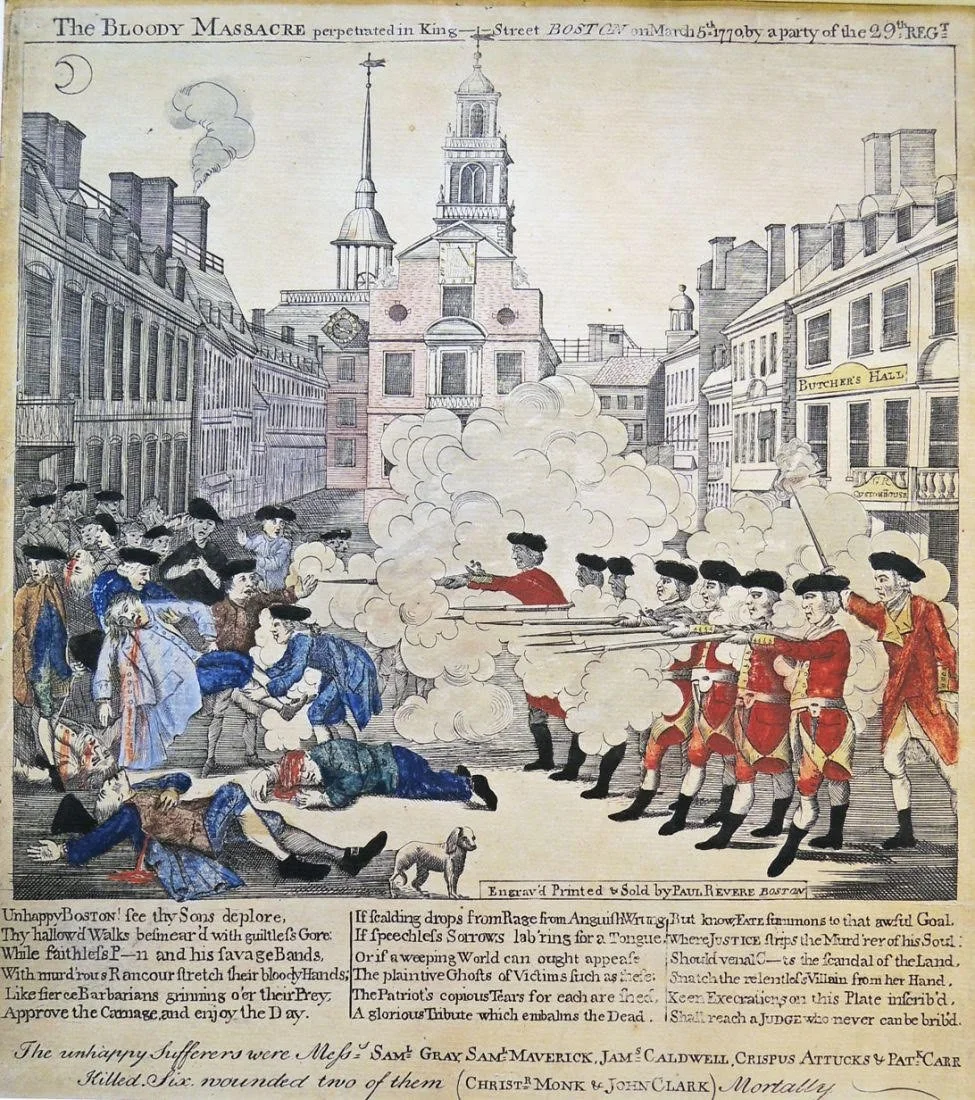
In the coming days, the story raced ahead of the evidence. British troops were occupiers in the eyes of the town, symbols of humiliation and coercion. An engraving circulated depicting the scene on King Street: soldiers in neat formation, firing in deliberate unison into a defenseless crowd. The smoke in the image parted conveniently. Captain Preston was shown giving the order. Above it ran the title that would echo far beyond Boston: The Bloody Massacre in King Street. In time, the shorter phrase would stick. It would be remembered simply as the Boston Massacre.
This violence did not erupt in a vacuum. For years, Massachusetts had been locked in a grinding struggle with imperial authority. Boston was not a rebellious outpost but a proud English town—part of the British Empire, loyal to the Crown, yet accustomed to governing its own affairs through local assemblies and town meetings. That long habit of self-rule had become a point of pride.
But after the costly global war against France—the very war that had secured the colonies from French and Native American threats—Parliament faced staggering debt. London concluded that the colonies, now safer and expanding, should contribute more directly to their own defense. New taxes followed. New regulations. Customs enforcement tightened.
To many in Britain, this seemed reasonable—an assertion of parliamentary sovereignty over imperial subjects. To many in Boston, it felt like a sudden narrowing of liberties they had long exercised without interference. A people accustomed to managing their own affairs began to see imperial oversight as intrusion. Resistance grew louder. Smuggling became defiance. And things often slipped over the boundary of what we would call today “peaceful protest.”
In 1765, a mob sacked the home of Lieutenant Governor Thomas Hutchinson, reducing it to ruin and stealing his valuables. Meanwhile, customs officials were being harassed in the streets and threatened into resigning. When John Hancock’s ship Liberty was seized in 1768 for smuggling, angry crowds attacked customs officers and drove some to seek refuge under armed protection.
To enforce order, in 1768, British troops were sent to Boston. Yet this occupation only deepened resentment. The soldiers competed with laborers for scarce work. They drilled on the Common. They patrolled streets where they were openly despised. Insults were constant.
On March 2, 1770, a British soldier, looking for off-duty work, approached Gray’s ropewalk. A rope maker’s apprentice mocked him, telling him that if he wanted employment he could “clean my master’s outhouse.” The soldier swung. The apprentice ran for help. Within minutes, ropewalk workers and soldiers were trading fists and clubs in the street. Pride was wounded on both sides. The town was a tinderbox. All it lacked was a spark.
Three days later, the shootings on King Street provided one.
The soldiers were arrested and charged with murder. Few lawyers were eager to take the case. To defend them was to risk public ruin. It was to invite mob violence, professional exile, and political suicide. The accused were already condemned in the court of popular opinion. Their guilt, to many, was a foregone conclusion.
Then a local attorney stepped up.
John Adams was already well known in Massachusetts—not as a friend of British power, but as one of its sharpest critics. His essays defending colonial rights had circulated widely. His pen had given voice to the growing conviction that Parliament had violated the liberties of Englishmen in America. He opposed the occupation. He resented imperial overreach. No one could plausibly mistake him for a loyalist. But Adams believed something more fundamental was at stake. If the law bent to the crowd now—if vengeance replaced judgment—then liberty itself would be hollow from the start.
He took the case knowing exactly what it would cost him. His practice suffered. His reputation suffered. He would later write that the defense was one of the most difficult decisions of his life. But he never wavered.
In the courtroom, Adams did something brilliant. He slowed the moment down. He stripped away the slogans and reconstructed the night as it was, not as it had already been remembered. He did not deny that men had died at the hands of British soldiers. He did not excuse the shots. Instead, he insisted on evidence—on sequence, proximity, fear, confusion.
Adams reminded the jury that soldiers, surrounded and struck, were still men capable of panic. But he did not ignore the larger fault. “The foundation of this transaction was laid by the Quartering of Troops in Boston,” he said plainly. Armed soldiers stationed in a crowded town “under a pretense of guarding and protecting it” had made friction almost inevitable. But cause was not the same as verdict.
And then he turned to the crowd itself.
“And what do we mean by a mob?” he asked. Not a peaceful assembly, but “a motley rabble of saucy boys, negroes and mulattoes, Irish teagues and outlandish Jack tars.” This was no orderly protest. The soldiers had faced clubs, snowballs packed hard with ice, taunts daring them to fire. One had been knocked down. Another struck. In that chaos, Adams argued, the law did not demand heroics. It demanded reasonableness. If a man reasonably believed his life was in danger, he had the right to defend it.
“Facts are stubborn things,” Adams declared. “And whatever may be our wishes, our inclinations, or the dictates of our passions, they cannot alter the state of facts and evidence.”
The verdict shocked the town. Six soldiers were acquitted. Two were convicted of manslaughter and branded on the thumb—not hanged. It was not the outcome the crowd wanted. But it was the outcome the law, carefully applied, required.
After the trial, Boston quieted—for a time. But resentment did not vanish. It hardened. Within three years, tea would be hurled into Boston Harbor. Within five, shots would ring out at Lexington and Concord. War would come, and it would begin in Massachusetts.
The memory of March 5 endured. It became part of the colonial case against Britain—engraved, printed, retold as proof of imperial arrogance. The phrase “Boston Massacre” would outlive the smoke on King Street.
But something else endured as well.
Before there was a Constitution, before there was a republic, Americans faced a test. Would justice yield to outrage—or submit to law? In Boston, in 1770, principle restrained passion. The most despised men in the province were given counsel. Evidence was weighed. Verdicts were rendered not by a crowd, but by a jury.
Other revolutions would choose differently. A few years later, in France, fury would become tribunal, tribunal would become guillotine, and guillotine would give way to emperor. Passion, once unrestrained, would consume the revolution it claimed to defend.
Boston nearly chose that path. It did not. That restraint—fragile, imperfect, incomplete—was one of America’s earliest rehearsals in self-government.
John Adams’ defense did not prevent revolution, of course, nor did he later wish to. It made something more enduring possible: a nation in which even power’s enemies were entitled to justice. “A government of laws, and not of men,” as Adams would later write.
But this question does not end. It never does. Today we tell ourselves we are safer from such temptations. We have video now—high definition, multiple angles, slow motion. Nothing is left to rumor or engraving. We can see what happened. And yet we still do not see the same thing.
The crowd no longer gathers beneath a winter sky; it gathers online—instantaneous and enormous. We watch. We decide. Only later do we ask what actually happened.
Adams would recognize the atmosphere. He understood something we still resist: evidence must be weighed, not weaponized. Context matters. Sequence matters. Fear matters—even when the uniform is unpopular, even when the protester is unsympathetic.
“Facts are stubborn things.”
They were stubborn in 1770.
They are stubborn still.

Tony Valerino is an author and independent researcher focused on American history and Western civilization. He has published two books, his most recent a history of the United States told through turning points that shaped the nation’s people and institutions. He also writes daily historical essays and reflections on his blog. Links below.
Pivotal Moments That Shaped America - https://a.co/d/g6qjSrw
Facebook blog - https://www.facebook.com/share/1FNLF42a8K/?mibextid=wwXIfr
Civilizations of the Ancient World - https://a.co/d/e65mKDD
Photo Credit: Paul Revere (1735-1818) after Henry Pelham (1748/49-1806), The Bloody Massacre perpetrated in King-Street Boston on March 5th 1770 by a party of the 29th Regt., [1770]. Engraving with hand color. Scheide Library, Gift of William H. Scheide, Class of 1936. (Library of Congress)