


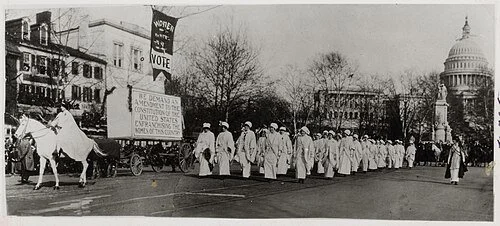
On March 13, 1913, an estimated 5,000-10,000 women gathered in Washington D.C. for The Woman Suffrage Procession. They marched down Pennsylvania Avenue the day before Woodrow Wilson’s presidential inauguration to raise awareness for women’s suffrage. They wanted the right to vote in local, state, and federal elections. They wanted to be able to elect leaders who would support the expansion of rights for women and causes important to women.
American suffragists Lucy Burns and Alice Paul who had first-hand knowledge of the successful, but aggressive women’s suffrage movement in the UK hoped to jumpstart the women’s suffrage movement in the Unites States by developing a national strategy for the National American Woman Suffrage Movement (NAWSA).
Paul selected the date and the venue to give the organization national exposure for their cause. She was immediately met with resistance from the D.C. police department.
District superintendent of police, Major Ricard H, Sylvester, offered Paul a permit to march down 16th Street, a residential area that would take the marchers past several embassies. He later claimed he offered the alternate route because he believed the women wished to march in the evening, a busy time when the police could not provide adequate security.
Paul appealed to the District commissioners and presented her arguments to the press. Under pressure the commissioners relented and approved the original parade route.
The planned procession was to include bands, floats, and groups representing women at home, school, and in the workplace. Women acting out historical events and symbolic riders entertained crowds along the route. The rally at the Memorial Continental Hall included prominent women speakers.
Black participation in the event threatened to cause a rift in the leadership. Several Southern delegations refused to march alongside Black suffragists and demanded they either be excluded or made to march at the back of the parade. Many Black delegates defiantly marched with their state delegations. A group of suffragists from Howard University marched together.
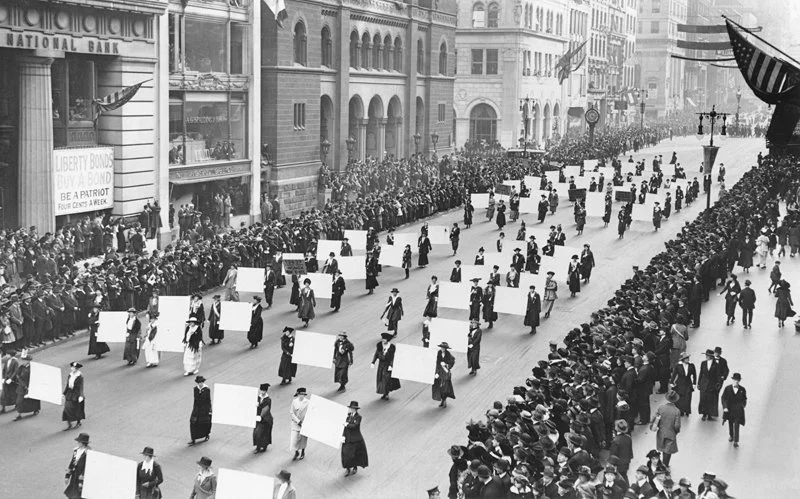
During the procession, district police neglected to keep the enormous crowd of spectators off the streets impeding the marcher’s progress. Hecklers infiltrated the crowd shouting, pushing, and threatening the marchers. Citizen’s Groups including the Boy Scouts, and eventually the cavalry stepped in to protect the marchers and restore order. Boys from the Maryland Agricultural College created a human barrier to protect the marchers from the angry crowd.
More than 200 people were treated for injuries at local hospitals.
After the march, a congressional inquiry criticized the response by the district police and highlighted several security failings. Major Sylvester insisted the blame lay with individual officers who disobeyed orders and defended his own actions. The committee exonerated him, but it cost him the respect of his department and public support.
Paul hoped the findings would emphasize the need for women to have a constitutional amendment guaranteeing their personal freedoms and the right to vote, but after promising to consider an amendment, President Wilson waited until 1918 to change his stance on the suffrage amendment.