


Millions of people around the world are reported missing each year. An estimated eight million of them are children. Over 72,000 migrants died or went missing between 2014 and 2024 according to the Missing Migrant Project.
Though many cases are resolved quickly, tens of thousands of people remain missing long-term. Most disappearances can be attributed to disasters, conflicts (especially on-going armed conflict), or crime.
Some people simply disappear, even if they are well-known public figures. In previous issues we explored the mysterious disappearances of Barbara Newhall Follett, Ambrose Bierce, Amelia Earhardt, and several other ‘famous” people in addition to other unexplained disappearances.
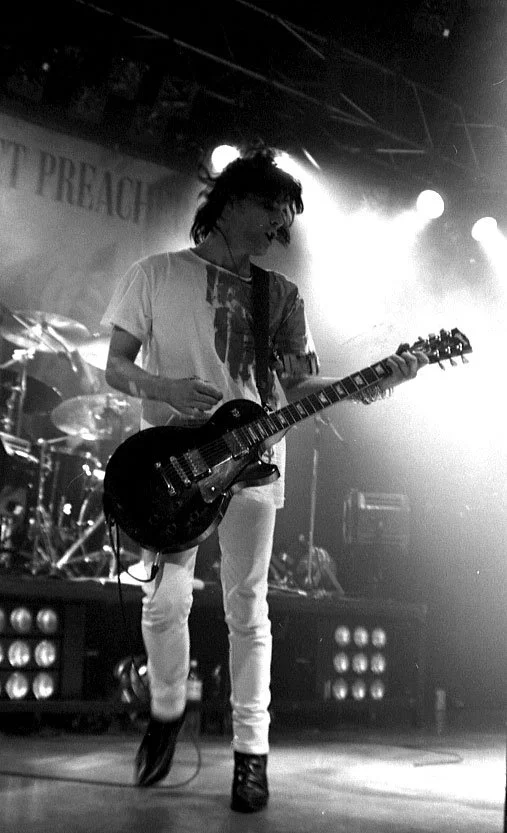
This year I selected the disappearance of Welsh musician Richey Edwards of the alternative rock band Manic Street Preachers who vanished without a trace over thirty-one years ago.
Richard James Edwards (AKA Richey Edwards and Richey Manic) was born December 22, 1967, and he disappeared on February 1, 1995. He wasn’t officially declared dead until November 24, 2008.
Edwards had a happy childhood despite struggling with anxiety and depression as an adult. He was a kind and supportive older brother to his sister, Rachel, who suffered from a childhood anxiety disorder. He met his fellow bandmates at the Oakdale Comprehensive School. Edwards earned a bachelor’s degree in political history from the University of Wales, Swansea.
He became a driver and roadie for Manic Street Preachers. In 1989, he joined the band as a performer and main spokesman. Though he played rhythm guitar, Edwards preferred to be known as the band’s principle lyricist. He wrote about 80% of the songs for their third album.
Edwards openly spoke about suffering from severe depression in interviews. He admitted his depression often led to self-harm. He would stub out cigarettes on his arms and cut himself to replace his mental struggles with physical pain which he felt was easier to manage.
After a reporter questioned Edward’s commitment to his craft, he responded by carving “4 REAL” into his forearm with a razorblade. The injury needed eighteen stitches.
He also suffered from insomnia and self-medicated with alcohol to be able to sleep.
In 1994 he checked himself into Whitechurch Hospital and later the Priory hospital. After missing several months of touring, Edwards rejoined the band for a European tour. His final live appearance with the band was at the London Astoria on December 21, 1994. Toward the end of their set, Edwards smashed his guitar and a free for all ensued. The band destroyed their equipment and most of the lighting system.
On February 1, 1995, the day Edwards and his bandmate, James Dean Bradfield were scheduled to fly to the United States on a promotional tour for their album, The Holy Bible, Edwards disappeared.
During the two weeks before his disappearance, He withdrew exactly £200 a day from his bank account for a total of £2,8000. Friends and family speculated that Edwards might have intended to pay cash for a desk he ordered and use the remaining cash during the promotional tour. The desk was never picked up, and the order wasn’t canceled.
The night before he disappeared, Edwards reportedly gave a friend a book titled, Novel with Cocaine and instructed her to read the introduction about the author checking into a mental asylum before disappearing.
He was staying at the Embassy Hotel in London where he left a gift-wrapped collection of books and videos for his on again off again girlfriend. The next morning, he collected his car keys, wallet, a prescription bottle of fluoxetine (Prozac), and his passport, then checked out of the hotel leaving his toiletries, luggage, and some of the fluoxetine in his room.
Authorities believe he drove to his home in Cardiff where he left his passport, the fluoxetine, and a Seven Bridge tollbooth receipt time stamped at 2:55. At the time, they assumed time on the receipt was 2:55 p.m., but in 2018, Sara Hawys Roberts and Leon Noakes, the authors of Withdrawn Traces, Searching for the truth about Richey Manic discovered evidence that disputed the time after the original software engineer at the bridge confirmed the software printed out of a 24- hour clock meaning Edwards passed through the tollbooth at 2:55 a.m.
Before he was reported missing, fans reported seeing Edwards at a Newport passport office and a Newport bus station. On February 7, a Newport cab driver claimed he picked up Edwards from the King’s Hotel and drove him around his hometown of Blackwood and the surrounding area. The passenger used a Cockney accent which often devolved into a Welsh accent. He asked to lie down in the back seat and be driven to the Blackwood bus station, then requested to be driven to the Pontypool railway station. When the Pontypool station didn’t have a pay phone, Edwards supposedly remained in the taxi until he asked to be dropped off at the Severn View service station near Aust, South Gloucestershire and paid cash for the fare.
On February 17, ten days after his supposed taxi ride, Edwards car was found abandoned near the Severn Bridge. The battery was dead. Three days earlier it had been ticketed for a parking violation. Upon examination, the car looked as if someone had been living in it for several days and recently taken photos of Edward’s family had been left in the car.
Since the Severn Bridge was a well-known suicide site, authorities believed Edwards had jumped from the bridge. Edwards had said publicly in 1994 that he would never commit suicide.
Since his disappearance there have been Richey Edwards sightings in Goa, India, and on the islands of Fuerteventura and Lanzarote in the Canary Islands among other locations. None of the sightings have been verified.
Police actions during the investigation into his appearance have received criticism from Edward’s family and independent researchers and investigators. The family had the option of declaring him legally dead beginning in 2002 but waited until 2008. As of 2005, the remaining members of Manic Street Preachers were still paying 25% royalties into an account in his name.
Photo Credit:
By Masao Nakagami - https://www.flickr.com/photos/goro_memo/7227817420/, CC BY-SA 2.0, https://commons.wikimedia.org/w/index.php?curid=115589757