





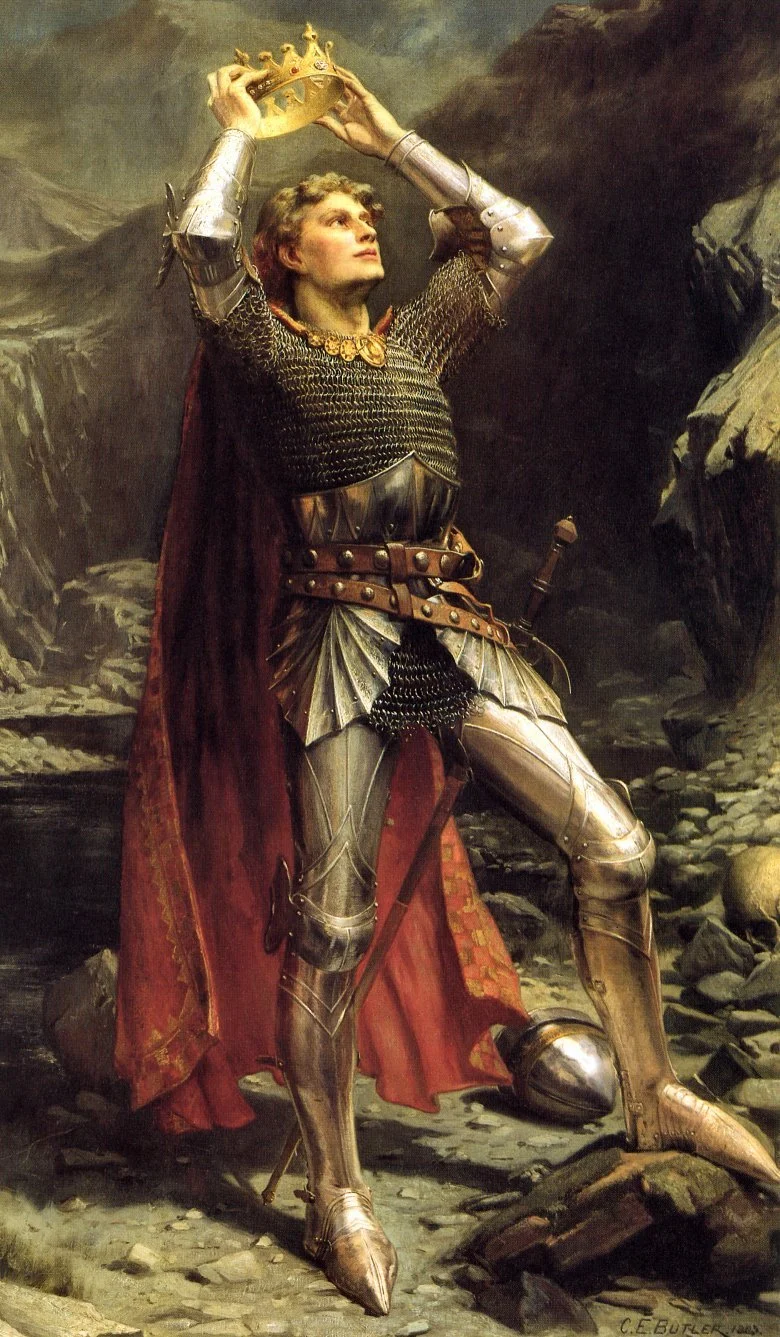
The hill is shrouded in mist. Below, the Saxons come on in waves—a sea of spears rising and falling. Their war cries carry through the damp air, sharp and certain. Britain is breaking.
At the crest stands a man the later ages will call king. But he is not crowned. There is no court, no banner stitched in gold—only a war leader among exhausted men, holding a line that has almost vanished. The Romans are gone. The roads are crumbling.
The old order has slipped into memory.
And yet here—sometime around the year 500—in a struggle later ages will remember as the Battle of Badon, the Saxon advance falters. He leads the charge. The invaders fall back. And for a moment—just a moment—Britain holds.
This great leader’s name, they will say, was Arthur.
Or perhaps it was not.
This is a subject that has always fascinated me. Late-Roman Britain. A lost world, half-remembered. A war leader standing against the collapse. Barbarian invasions. Who wouldn’t find such a story compelling?
But the question remains. Is this entire story made up? Was there ever even a real Arthur?
In AD 410, after almost four hundred years, Rome abandoned Britain. Emperor Honorius, facing crises across the continent, told the cities of Britain to look to their own defense. The legions packed up and left.
What remained was not a nation, but a fragment: Roman towns without Roman protection, local rulers without imperial authority, a society still half-Roman, half native—and suddenly alone.
Into that vacuum came new peoples—Angles, Saxons, Jutes—first as hired warriors, then as settlers, and finally as conquerors. Sometime around the middle of the 5th century, according to later tradition, the Saxon leaders Hengist and Horsa arrived with bands of mercenaries, invited in to defend Britain. They did their job—and then decided to stay. More came. Then more still.
What began as assistance became occupation. Then conquest.
Archaeology confirms the pattern: destruction layers, abandoned settlements, a shift in material culture. A world in transition—and in many places, a world in collapse.
It is in this broken landscape, between roughly 450 and 530, that the shadow of Arthur appears.
The earliest voice we have is the monk Gildas, writing around 540. He tells us of a great victory—one that halted the Saxon advance for a generation. He describes a leader named Ambrosius Aurelianus, a Romano-British figure who rallied resistance. And he recounts the triumph at Badon as the turning point of his age.
But he does not mention Arthur. Or was Aurelianus later changed to Arthur? This is the first mystery.
But we can be pretty sure that something major did happen. The archaeology suggests it. Around the year 500, the chaos—burning, raiding, collapse—eases in parts of southern Britain. For a generation or more, there is relative peace, and Romano-British culture continues. The Saxon advance slows, even halts along a rough east–west divide.
A real victory had been won. A real line had been held.
A few centuries later, around 830, another writer—Nennius—does name him. In his Historia Brittonum, Arthur is no longer absent but central: a war leader, not yet a king, who fought twelve battles against the Saxons, culminating at Badon, where he is said to have personally cut down hundreds in a single day.
By then, nearly three centuries had passed. Memory had begun its work. Yet there are still hints—fragments—that something more than legend was already at play before this.
In the generation after Badon, four royal houses in Britain each named their heir “Arthur.” This was not a common name before this period. That is not easily explained if Arthur were only a legend. It suggests that somewhere behind the story, there was a man worth remembering.
Who was he?
Perhaps a Romano-British commander, descended from families that had lived under Rome and still carried its memory. A man who may have spoken Latin as well as a native British tongue. A Christian, in a land where the invaders were pagan. A leader who looked backward—to Rome—in order to move forward.
Not a king in the medieval sense, but something older. A dux bellorum—a war leader.
And perhaps, somewhere in the south of Britain, we can still glimpse his world.
In the 20th century, archaeologists excavated Cadbury Hill in Somerset—long associated in later tradition with Camelot. What they found was striking. An ancient hill fort, abandoned for centuries after the Roman peace, suddenly reoccupied and massively refortified in the late 5th century. Thick stone walls. Complex defenses. Evidence of a large, organized community—far larger than a typical war band of the time.
Someone had gathered these people. Someone had commanded resources, loyalty, vision.
Not proof. But not nothing either.
If there was a man behind the legend, this is the kind of place he might have ruled from. Not a glittering court—but a stronghold in a collapsing world. And perhaps he did what the stories say. Perhaps he rallied the Britons, invoked the memory of Rome, and struck hard enough at Badon to stop the advance.
For a time.
Because in the end, it did not last.
The Saxons would come again. And in the long run, they would win. The language we speak today is theirs, not his. Whatever peace was won at Badon, it was temporary.
Which makes what comes next all the more remarkable. Because the man—if there was a man—did not disappear. He grew.
By the time of Geoffrey of Monmouth in the 12th century, the story transforms completely. In his sweeping narrative, Arthur becomes king—ruler of Britain, founder of a golden age, a figure of destiny rather than history. Merlin enters the tale. The court takes shape.
And from there, the legend expands.
Camelot rises. The Round Table gathers. Knights swear oaths. A sword is drawn from stone. A war leader in a forgotten age becomes the centerpiece of an entire moral universe.
Writers across Europe take up the story. Chrétien de Troyes adds romance and chivalry. Wace reshapes the narrative for new audiences. The story crosses the Channel, grows, deepens, changes.
And then—something even stranger happens.
The story grows more complicated when the Saxons, who had once pressed into Britain as invaders, are themselves conquered by the Normans in 1066. The Norman kings, ruling a conquered Anglo-Saxon land, had every reason to embrace a deeper, pre-Saxon past. In Arthur, they find it.
In the Elizabethan Age, he transforms again. Arthur no longer belongs to a lost Britain resisting Saxons. He belongs to a rising England. Under Elizabeth I, he fully becomes part of national identity. Writers like Edmund Spenser cast him as the embodiment of virtue—a symbol not of what was, but of what England believes itself to be. Arthur becomes less a man than a mirror.
In the 19th century, during the long confidence of empire, he is reborn again—this time in the poetry of Alfred, Lord Tennyson. In Idylls of the King, Camelot becomes a moral world—order against chaos, purity against corruption. Arthur is no longer merely a warrior. He is an ideal. And like all ideals, he falls. Not from invasion—but from within.
In the modern age, on screen, in novels, in retellings that range from gritty realism to high fantasy, Arthur becomes whatever the age needs him to be: a flawed leader, a reluctant hero, a myth stripped down or built back up.
All of which brings us back to the beginning.
Was he real?
Well—possibly.
There are fragments that suggest a historical core: a Romano-British leader in the late 5th or early 6th century, fighting in the chaos after Rome’s withdrawal. The victory at Badon itself is widely accepted as real, even if its details—and its commander—remain uncertain.
But the Arthur we know—the king, the court, the legend—comes later. Built across centuries. Layer upon layer.
From silence in 540… to emergence in 830… to full legend by 1136… and beyond.
The story endures because it was never just a story. Post-Roman Britain truly was a place of collapse. The legions truly left in 410. The invaders truly came. And somewhere in that darkened landscape, someone—some leader or group of leaders—stood and fought back hard enough to be remembered.
Was his name Arthur?
Perhaps.
But the legend tells us something deeper than the answer. Because in the centuries that followed, people did not just remember him—they waited for him. Not merely as a king who had been. But as one who would return. The once and future king.
And that may be the clearest truth of all. Not that Arthur was a great king. But that in the ruins of a broken world, people needed one.
Tony Valerino is an author and independent researcher focused on American history and Western civilization. He has published two books, his most recent a history of the United States told through turning points that shaped the nation’s people and institutions. He also writes daily historical essays and reflections on his blog. Links below.
Pivotal Moments That Shaped America - https://a.co/d/g6qjSrw
Facebook blog - https://www.facebook.com/share/1FNLF42a8K/?mibextid=wwXIfr
Civilizations of the Ancient World - https://a.co/d/e65mKDD