




In the age of powerful data-driven marketing, pampering has been rebranded as “self-care.” The label can now be attached to almost any product or service. In theory, you could self-care your way into debt if you accepted every offer designed to optimize, soothe, or improve you.
In the past, I have paid for a range of self-care products and services, and I am not entirely opposed to traditional or modern spa treatments, expensive elixirs, or beauty products. But I am increasingly skeptical of anything that claims to improve your life or health while overlooking the simplest, most accessible forms of care already available to us.
Walking, sunlight, family and friendship, and good sleep are the most reliable foundations. Alongside these, I find comfort in small, inexpensive rituals: organic shea butter for the skin, herbal tea, and quiet time alone.
These “almost free” forms of care often feel more restorative than anything I can purchase. Clean sheets, a warm shower, and candles can shift my entire state of mind without requiring a decision, a booking, or a transaction.
By contrast, an expensive facial or massage often introduces its own friction. Finding a reputable spa, selecting the right service, justifying the price, and sitting with a stranger in a carefully curated environment can add a layer of tension rather than remove it. I often find I would rather stay home, using simple, natural products—a homemade face mask costing only a few dollars—and enjoy the quiet privacy of my own space.
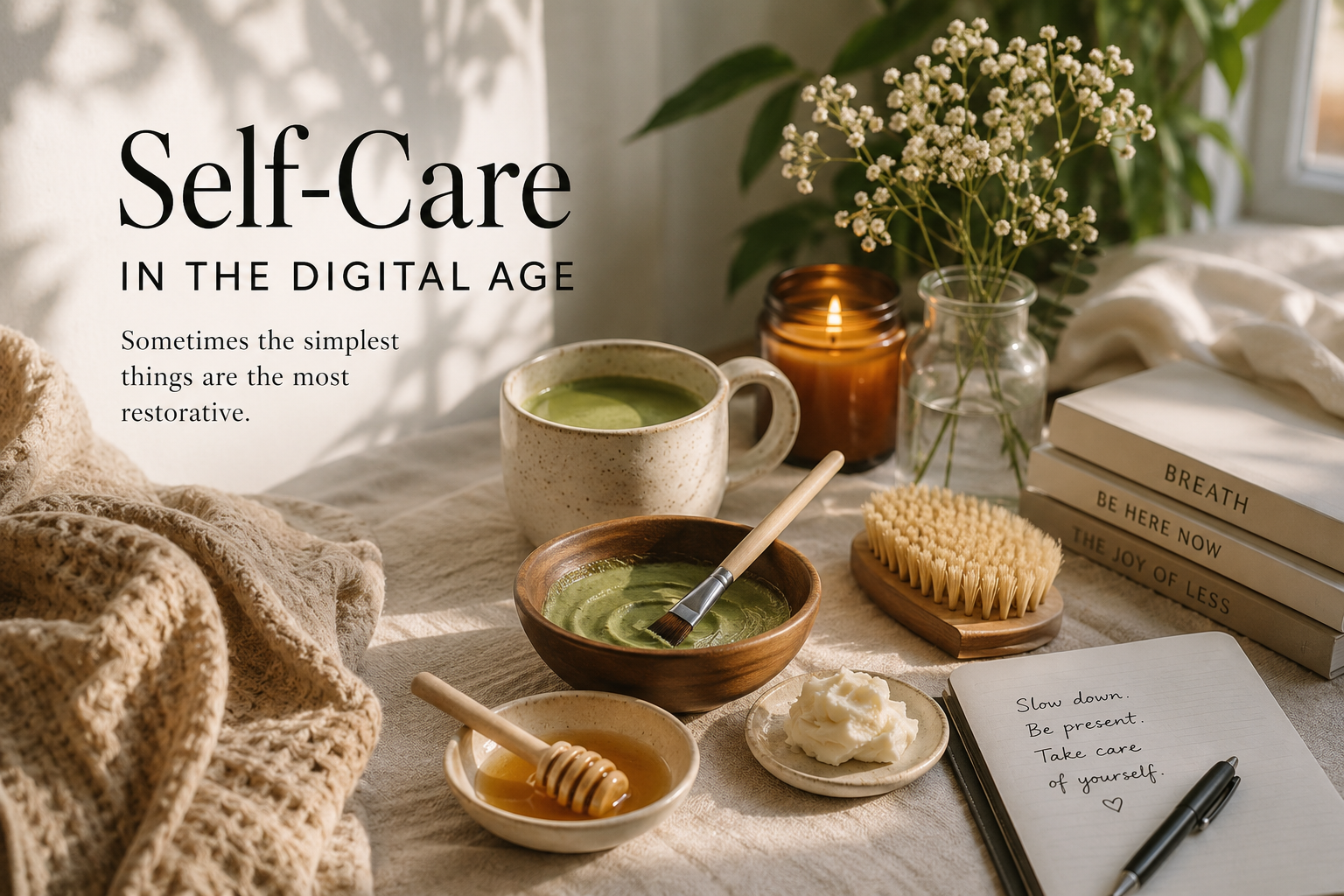
My favorite DIY mask is aloe vera, honey, and matcha, which I use to calm, hydrate, and purify the skin. If matcha is unavailable, brewed green tea works just as well. Honey can be substituted with coconut oil or shea butter. These small substitutions reflect a larger idea: care does not need to be complex to be effective.
The same applies to hair and body care. A good boar-bristle brush, for example, can do more than many specialized products, distributing natural oils from root to tip. Often, we don’t need more products—we need simpler habits.
Yoga is another form of care that requires nothing beyond time and presence. I prefer practicing alone at home rather than in a studio. For those who enjoy community, outdoor yoga offers a balance of movement, sunlight, and affordability. Either way, the value lies not in the setting, but in the act itself.
Self-care can also be as simple as turning off your phone, taking a nap, sleeping in, or baking cookies. It does not need to cost $50 for a pedicure or $150 for a massage to be meaningful.
Even connection can be a form of care. Calling or visiting a friend may offer more emotional relief than any paid service. It might cost a cup of coffee, but it is still less than an hour of therapy. Ironically, even this idea has been absorbed by marketing culture—I recently saw a sidewalk sign outside a nail salon that read: “Nails are cheaper than therapy.”
That phrase captures the tension perfectly. It is true on the surface, yet it also reduces care into commodity and consumption.
My ideal self-care day is not built around purchase or optimization, but rhythm and simplicity. I would wake naturally, move my body gently through yoga, and breathe before reaching for anything external. I would make a matcha latte, read, and write in the quiet of the morning. Later, I would prepare a simple face mask and spend time painting or engaging in low-pressure creative work.
Nothing in this day is exceptional or expensive. Yet everything is intentionally caring.
Because in the end, self-care is not something I buy or perform correctly or better — it is something I return to. A way of remembering that attention, rest, and simplicity are not products; they are luxuries I can always give to myself.
In a world that constantly tries to sell us better versions of ourselves, choosing what is simple, quiet, and enough may be the most radical form of care we have left.
Image:
Courtesy of the author - taken from ChatGPT on June 1, 2026.
Scarlet Carter is a pen name for a local Pittsburgh author who wishes to remain anonymous as the details of her work are sometimes based on true events. Scarlet also writes fiction and is currently working on her first novel.