






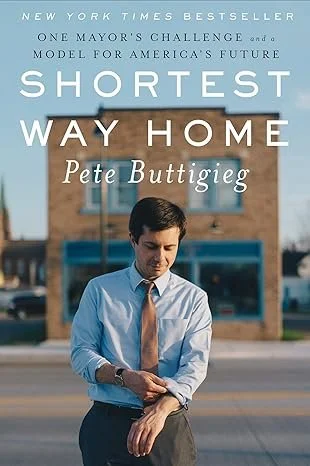
This month I read Shortest Way Home: One Mayor’s Challenge and a Model for America’s Future by Pete Buttigieg.
His parents were college professors. Buttigieg graduated from Harvard University and attended Oxford as a Rhodes Scholar.
He worked in consulting before returning to his hometown of South Bend, Indiana. Elected at 29, he served two terms as the mayor of South Bend (2012 – 2020).
He is the first openly gay man to launch a Democratic presidential campaign winning the Iowa caucuses and placing second in the New Hampshire primary before dropping out and endorsing Joe Biden. From 2007 to 2017, he was an intelligence officer in the United States Navy Reserve. Buttigieg was deployed to Afghanistan for seven months in 2014. He served as the Secretary of Transportation during the Biden administration (2021-2025).
South Bend is a midwestern city in the Rust Belt. Once a thriving community adjacent to the University of Notre Dame, it was home to a large Studebaker plant until 1963, when the plant closed. The town went into a decades long decline with double-digit unemployment and a diminishing population as people moved away in search of jobs. Abandoned factories, businesses, and homes slowly decayed waiting for a second chance.
Buttigieg and his friends grew up seeing this urban decay as normal. They played, attended school, went to neighborhood parties, and enjoyed the ethnic cuisine and customs of their African American neighbors and Eastern European ancestors.
As he got older, Buttigieg learned more about the golden era of South Bend when it was home to South Bend Pocket Watches, an American watch company founded by the Studebaker brothers in 1903 and a Studebaker factory (1852-1963) which manufactured wagons, buggies, carriages, harnesses and eventually cars.
He saw old photos of the bustling community and wondered if his city would ever return to form.
His interest in history extended to politics and volunteerism.
The question of how he would make a difference in his community was forming. Buttigieg volunteered for several democratic political campaigns, quietly observing and learning from each success and failure.
After graduating college, working, and traveling extensively for several years as a business consultant solving problems and expanding business markets for his clients, he made the decision to move back to South Bend and eventually decided to run for state treasurer of Indiana in 2010. He was motivated to run after the incumbent treasurer invested state pension funds in Chrysler junk bonds then filed a lawsuit against Chrysler’s bankruptcy restructuring. Had Chrysler not survived, those bonds would have become worthless. Mourdock centered his campaign on Buttigieg’s age and lack of government experience. After he lost, Buttigieg learned from his mistakes and set his sights on the office of mayor.
After winning the election, the new mayor prioritized keeping his campaign promises. Over the course of his first term, Buttigieg admits he was forced to make some unpopular choices. Not everyone embraced technology and the idea of Smart systems for public utilities was a hard sell. He had to deal with racial divisions in the community, law enforcement issues, and prioritizing and securing funding for various projects. He’s quick to give credit to his predecessors for projects they started which he completed, and equally willing to take responsibility for initiatives that didn’t pan out.
In the current political climate, it’s so refreshing to hear a politician admit they made mistakes and then worked to rectify the situation instead of playing the “blame game.”
I enjoyed reading about the Buttigieg family, their friends, and neighbors. Buttigieg references his sexuality, but he was reluctant to come out because of policies like “Don’t Ask; Don’t Tell” which would have prevented him from serving his country as a naval intelligence officer, or the bill supported by Indiana Governor Mike Pence for Religious Freedom Restoration which permitted discrimination against LGBT persons.
It wasn’t until after his deployment in Afghanistan ended, that Buttigieg decided he was ready to embrace his sexuality. After he came out, he won reelection with 80% of the vote.
He met the love of his life, Chasten Glezman, a Chicago teacher, originally from Traverse City, Michigan. The story of their relationship is beautiful.
There are so many reasons to read this memoir. It’s honest, humble, and shatters stereotypes about how members of the LGBTQIA+ community think, behave, and want to be perceived. It’s also so much more than a book about coming out. It’s about embracing the future of technology instead of clinging to the past and working together to create bipartisan solutions to problems and provide opportunities for everyone.
Most of all, this book proves you can go home again, and sometimes it’s exactly where you were always meant to be.
Other works by Pete Buttigieg:
Trust: America’s Best Choice (2020)