





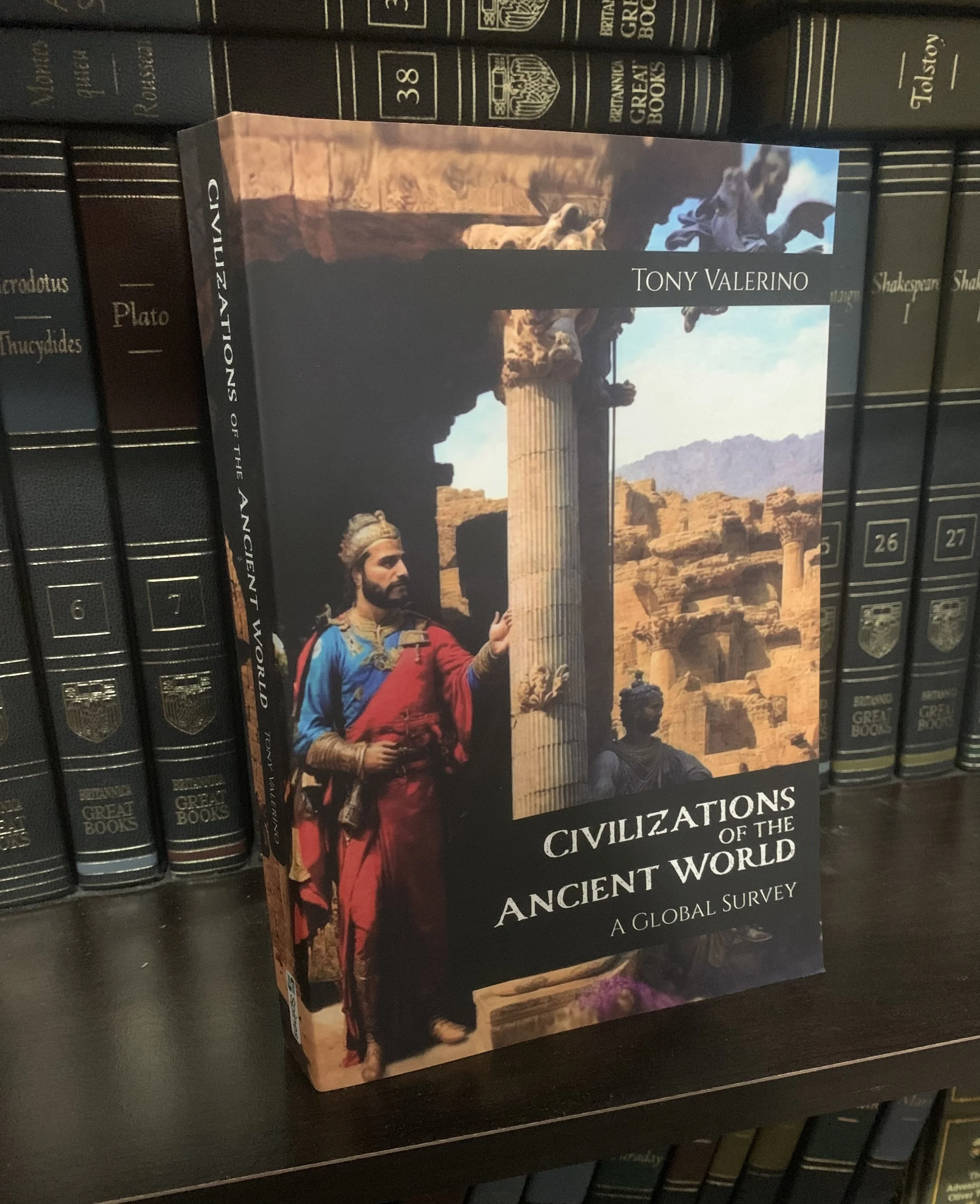
In our November 2024 Q&A, we featured author and blogger Tony Valerino and his first book, Civilizations of the Ancient World: A Global Survey. Valerino is also the author of the popular history blog, Pivotal Historical Moments fan, on Facebook.
If you missed the first Q&A, it’s worth reading or reading again. Here is the link:
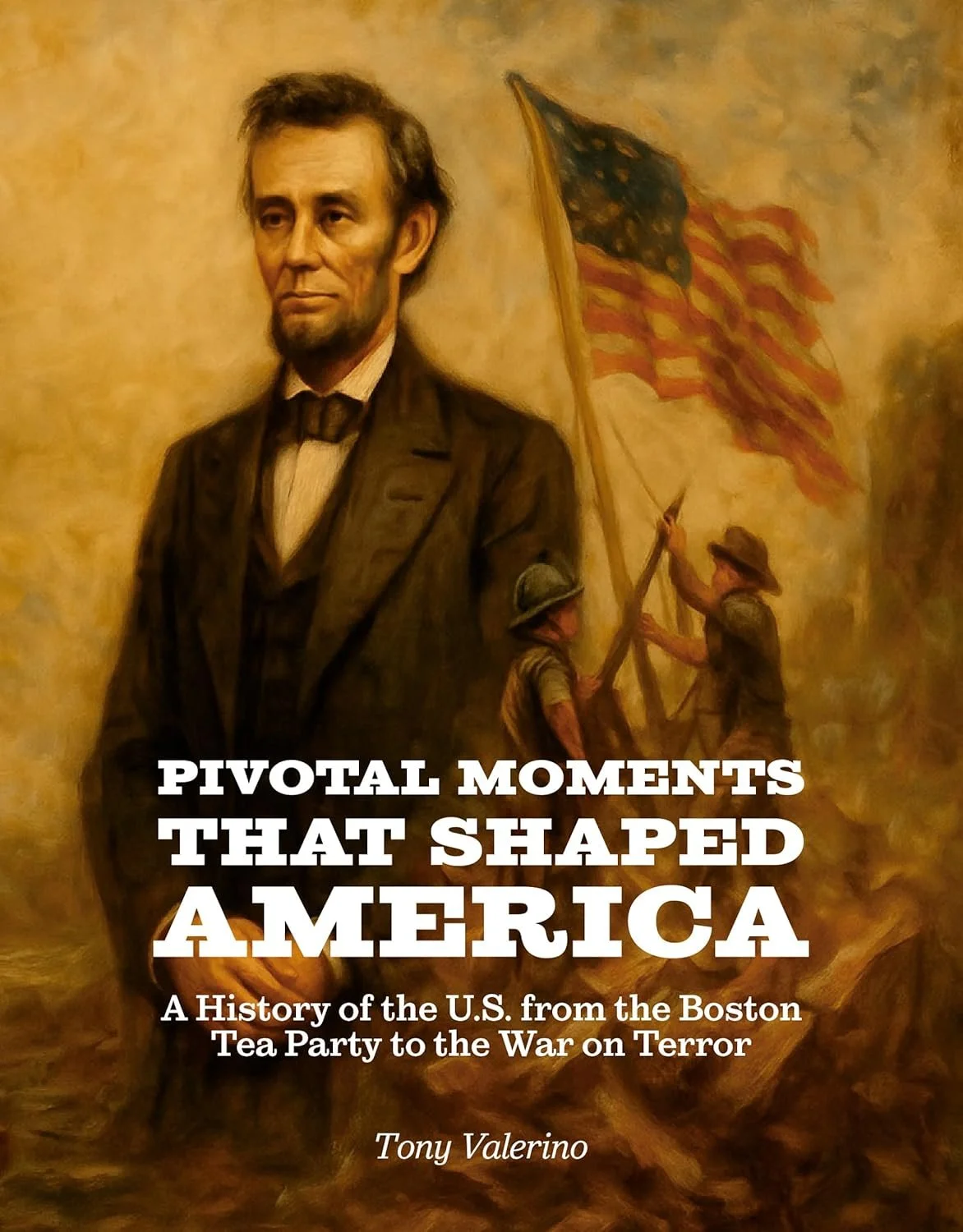
At the end of 2025, he published his second work, Pivotal Moments that Shaped America – History of the U.S. from the Boston Tea Party to the War on Terror. It’s a project he started working on during the pandemic, and recently revisited. I, for one, am so glad he did.
Valerino is a native of Mount Lebanon, a South Hills suburb of Pittsburgh, Pennsylvania. He was a scholar athlete at Mount Lebanon High School and attended the University of Kentucky where he excelled in academics and ice hockey.
He currently works as a program operator and machinist for a company in the Pittsburgh area. He and his wife, Heather, recently welcomed their fifth child.
His books are available on amazon.com and barnes&noble.com.
Here are Tony Valerino’s answers to my questions about the importance of the historical events he features in his book and why presenting history accurately is so important.
1. Pivotal Moments that Shaped America – A History of the U.S. from the Boston Tea Party to the War on Terror. How did you choose the title and why?
I wanted the title to signal both scope and method. The book tells a continuous story—from the Boston Tea Party to the War on Terror—but it doesn’t pretend to be a survey textbook that hovers above events in a neutral glide. Instead, it zooms in and out on pivotal moments when the American experiment was bent, tested, or nearly broken, reflecting how history actually unfolds: unevenly, through crises.
I also wanted to incorporate my blog’s name and make clear that this was a book about turning points, not a comprehensive catalogue of dates. Many of the moments I focus on are familiar in outline but misunderstood in consequence. Almost everyone knows the basic story of the Constitutional Convention, for example, but far fewer people understand the role played by Shays’ Rebellion—a populist uprising of indebted Massachusetts farmers that alarmed political leaders across the country. The rebellion exposed just how weak the Articles of Confederation were: the federal government couldn’t raise troops, regulate commerce, or reliably guarantee order, leaving states to fend for themselves. For leaders like George Washington, Alexander Hamilton, and James Madison, the fear wasn’t merely disorder—it was that the Revolution itself might collapse into chaos.
The Philadelphia Convention, called in the wake of this crisis and authorized only to amend the Articles, ultimately went far beyond its mandate. Its delegates discarded the existing system altogether and drafted an entirely new Constitution, using methods that were, strictly speaking, extralegal.
Anchoring the book between the Boston Tea Party and the War on Terror also makes clear what the book does not attempt to do. It touches only briefly on early colonial history and deliberately stops short of contemporary politics, ending instead with the War on Terror as the final chapter.
2. You started working on this book, but stopped, and eventually decided to tackle the subject of ancient civilizations. Did studying ancient civilizations change how you view American history? What impact did it have on this book?
Studying the Founding generation is actually what pulled me into ancient history in the first place. Their education was steeped in the classics in a way that’s hard for us to fully appreciate today. They didn’t just admire antiquity—they inhabited it intellectually. They read Livy, Plutarch, and Cicero not as distant figures, but as guides and warnings. They quoted Roman history to one another in private letters, argued over it in public essays, and measured their own political choices against ancient examples. Reading their correspondence—and then opening a modern social media app—is enough to make anyone mourn the collapse of serious civic language.
That classical inheritance runs all through early American life. The founders called their system a “republic” deliberately as a claim about power, virtue, and restraint. They modeled institutions on Roman precedents—the Senate, the fear of faction, the suspicion of demagogues, the obsession with corruption and decline. Even the architecture of Washington, D.C. reflects this mindset: columns, domes. They had absorbed Edward Gibbon’s warning that sophisticated civilizations collapse not from barbarian invasion alone, but from internal decay—loss of discipline, civic virtue, and institutional balance.
But studying ancient civilizations also widened my lens beyond what the founders themselves knew. They believed Rome to be the pinnacle of human political achievement largely because they had no serious knowledge of civilizations outside the Greco-Roman world. That information wasn’t available to them. For me, learning about ancient China and India—societies that developed complex bureaucracies, legal traditions, philosophies of order, and long-lasting institutions—forced me to see American history not as the culmination of a single classical story, but as one experiment among many in how human beings organize power and meaning.
That broader perspective changed how I approached this book. I became less interested in treating American history as a straight line of progress and more interested in treating it as a series of recurring tests—tests every civilization faces: rebellion versus order, liberty versus authority, moral certainty versus restraint. Studying the ancients taught me that the American story isn’t exceptional because it escaped those patterns, but because it argued with them openly, consciously, and repeatedly. That sensibility shaped the writing itself: fewer moral verdicts delivered from on high, more attention to crisis points, and a deeper respect for how fragile even the most well-designed republics really are.
3. Of all the events you covered in the book, which one was the most difficult to write about objectively?
The chapters on Reconstruction were the most difficult for me to write about objectively. Not because the moral stakes are unclear—they aren’t—but because Reconstruction represents one of the greatest missed opportunities in American history.
Slavery’s presence at the nation’s founding was a profound tragedy, but it did not make the United States unique. Slavery was a near-universal institution across much of the world for centuries. What was extraordinary was what followed: the rise of abolitionism across the Atlantic world, its growing force within the United States, and a civil war that—after the Emancipation Proclamation—became a crusade against human bondage.
Even more extraordinary was what came next. For a brief period after the war, the United States attempted something genuinely radical: a multiracial democracy backed by constitutional authority. Formerly enslaved men voted, held office, served on juries, and helped rewrite Southern governments. The Radical Republicans, working alongside freedmen and women themselves, pushed through the Thirteenth, Fourteenth, and Fifteenth Amendments—transformative changes that redefined citizenship, equality before the law, and political rights.
And then, slowly but decisively, much of it was undone. Through political compromise, Northern exhaustion, open racism, and outright violence, Reconstruction collapsed. By the early twentieth century, many African Americans in the South were trapped in sharecropping arrangements that closely resembled slavery by another name—bound by debt, denied freedom of movement, and stripped of the vote. A century after emancipation, the promise of freedom remained largely theoretical.
What made this section especially painful to write was knowing that the legal tools for justice already existed. Those Reconstruction amendments never disappeared; they lay dormant in the Constitution, waiting. When courts finally enforced them during the civil rights era, they did not invent new rights—they resurrected old ones. That long delay—the lost century between promise and fulfillment—is what makes Reconstruction so devastating. It was not a failure of ideals, but a failure of will.
4. Which U.S. historical figure or figures featured in your book do you admire most and why?
I write a great deal about the Adams family—John, Abigail, and their son John Quincy—and I don’t apologize for it. If I had to choose figures I admire most, John Adams and Abigail Adams would be at the top of the list.
John Adams appears early and often because he was indispensable at several decisive moments. In the opening years of the Revolution, he was one of the few figures relentlessly pressing hesitant colonial leaders to vote for independence when delay still felt safer. He understood that half-measures would be fatal. Yet what makes Adams especially compelling is that he was not a romantic revolutionary. He was, in many ways, a conservative revolutionary—deeply suspicious of mobs, power, and moral certainty.
That temperament explains one of the most revealing episodes of his life: his decision to defend the British soldiers accused in the Boston Massacre. Adams believed the soldiers had acted largely in self-defense, and he insisted that even the soldiers of an enemy deserved a fair trial. The case damaged his law practice and reputation, but he never regretted it. As he argued in court, “Facts are stubborn things.” For Adams, the rule of law mattered more than popularity—even in a revolutionary moment.
That same instinct reappeared during his presidency. When war fever against France swept the country during the Quasi-War, Adams could have easily embraced it and likely secured a second term. Instead, he broke with much of his own party and pursued peace, convinced that war would endanger the republic. Most historians—and Adams himself—believed that decision cost him reelection. He accepted that outcome without bitterness, convinced that preserving peace was worth the political price.
Abigail Adams is inseparable from this story. She was not merely supportive; she was John’s intellectual equal and often his moral compass. Their correspondence is among the richest personal records we have from the founding era—warm, substantive, and intellectually serious. John relied on her judgment, and he knew it. Abigail argued for women’s political equality, warned against tyranny, and expressed views on race and liberty that were well ahead of her time. I devote a biographical section to her because she was not simply the wife of a founder—she was a founder in her own right.
Together, the Adamses represent a strain of American leadership I deeply admire: principled, intellectually serious, willing to stand against their own side, and more concerned with the long survival of the republic than with personal glory.
5. What is the biggest myth about isolationism?
The biggest myth about early American isolationism is that it meant withdrawal from the world. Historically, the U.S. almost never did. When figures like George Washington warned against permanent alliances in his Farewell Address, he was not advocating disengagement. The young republic traded globally, sent diplomats abroad, expanded commercially, and fought wars when it believed its interests required it. What Washington and his successors sought to avoid was being pulled into great-power conflicts that served other nations’ ambitions more than America’s own.
And even that restraint had limits and was often just not practiced. The United States fought Britain in the War of 1812, Mexico in 1848 in the Mexican–American War, and Spain in 1898 in Spanish American War.
6. You included historical vignettes about lesser-known Americans and their contributions to our society. How did you decide who to feature?
Some figures—Abigail Adams, Henry Clay, and Eleanor Roosevelt—were obvious choices for me. I’d admired them for years, and their influence on American political culture, moral language, and reform movements is undeniable yet sometimes overlooked. They helped me fill gaps in the story I was trying to tell.
Others emerged more organically through the source material. James Longstreet is a good example. He was one of the Confederacy’s most capable commanders, yet after the Civil War he aligned himself with the Radical Republicans, supported Reconstruction, defended the rights of freedmen, and even fought armed confrontations against white supremacist paramilitary groups in the South. Longstreet’s life complicates easy moral sorting. He’s a reminder that historical figures are not static symbols, and that moral courage can appear—sometimes late, sometimes imperfectly—in unexpected places. His story reinforced for me how careful we should be about judging the past through modern sensibilities.
My favorite biographical vignette, though, may be the one on Fred Rogers. A Pittsburgh legend, Rogers is often remembered as gentle or sentimental, but the deeper you go, the more remarkable he becomes. Through Mister Rogers’ Neighborhood, he offered children a moral vocabulary built on dignity, patience, and empathy at a time when television increasingly rewarded noise and cruelty. He didn’t change the world through legislation or war, but he made it measurably kinder—and that, too, is a form of civic contribution worth taking seriously.
7. Looking back, were any of these people unexpected additions?
Louis F. Post was by far the most unexpected addition. I’ve been studying American history for many years, and until a couple of years ago I had never even heard of him—which is largely because he didn’t take credit and it took historians digging to discover all he did.
Post served as Assistant Secretary of Labor during the Red Scare following World War I, at the height of panic over anarchism and Bolshevism. When A. Mitchell Palmer launched the Palmer Raids, thousands of immigrants were arrested, often without warrants, held without due process, and marked for deportation on the thinnest suspicion of radicalism. Post was the official who reviewed those deportation orders—and instead of rubber-stamping them, he insisted on evidence, law, and constitutional procedure.
Almost single-handedly, he overturned hundreds of deportation cases, arguing that fear was no substitute for proof and that political belief was not a crime. He paid a price for it. He was attacked in the press, denounced in Congress, and accused of being soft on radicalism—or worse. At one point, there was even an attempt to impeach him. Post never denied the reality of political violence, but he refused to abandon the rule of law in response to it.
What struck me most was how lonely his stand was. Post had no mass movement behind him, no expectation of historical recognition, and no guarantee that he would be remembered kindly—if at all. He simply believed that constitutional rights meant little if they vanished during moments of fear. Including him in the book felt less like a choice and more like a correction.
8. Storytelling is an effective way to make history memorable and entertaining. How did you resist the temptation to embellish certain details?
I resisted embellishment because history rarely needs it. Human beings, taken seriously, are already astonishing—capable of extraordinary cruelty and extraordinary courage without any help from a writer’s imagination.
Take Theodore Roosevelt. You don’t have to exaggerate him to make him memorable. He boxed fellow politicians in the White House, once continued a speech after being shot because he judged the wound non-fatal, and regularly invited diplomats and journalists on brutal “strenuous life” hikes that left them exhausted or injured. He kept an assortment of animals—snakes, birds, even a badger—while his children famously turned the White House into something resembling a small zoo. He charged up San Juan Hill, explored uncharted rivers in the Amazon at great personal cost, and read a book a day when time allowed. All of that is simply true.
9. In your previous Q&A, we discussed the importance of myths in the study of history. Which American myth(s) had the greatest impact on the development of the United States?
I think the American myth that had the greatest impact is the belief that the nation was chosen—that it had a providential role to play in history. From the very beginning, Americans did not merely see themselves as another people building a state; they believed they were participating in a moral experiment with consequences beyond themselves.
That idea appears early in John Winthrop’s vision of a “city upon a hill,” a community whose success or failure would be watched by the world. Over time, that religious language secularized but did not disappear. It reemerged as Manifest Destiny, as the belief that republican government was humanity’s political future, and later as the idea that the United States had a unique responsibility to defend freedom abroad. Whether one views those beliefs as noble or dangerous, they undeniably shaped American expansion, diplomacy, and self-understanding.
10. The historical contributions of women and minorities have often been overlooked or reduced to footnotes. How do we change that, and how do we make sure history remains inclusive?
We change it by writing better history, not by lowering standards or adding people as an afterthought. Inclusion doesn’t mean reshaping the past to fit modern sensibilities; it means taking power, agency, and evidence seriously wherever they appear.
Many women and minorities were not marginal to American history—they were central to it. They played decisive roles in the Second Great Awakening, the abolitionist movement, and temperance societies; they shaped the nation’s moral language, built institutions, and pressed political arguments long before they were formally allowed to vote or hold office. In the book, I was able to incorporate much of this into the main narrative, and where the larger story moved on, I used my short biographical vignettes to fill gaps and restore figures who had been doing essential work all along.
11. What did you learn about indigenous civilizations in North America that surprised you the most?
What surprised me most was how sophisticated many Indigenous civilizations in North America actually were—and how persistently earlier histories underestimated them. Societies such as the Haudenosaunee Confederacy governed large territories through complex systems of law, diplomacy, and consensus, while cities like Cahokia sustained large populations through advanced agriculture and continent-wide trade networks. These were not marginal or primitive cultures; they were functioning civilizations with their own political logic and social order, many of which were devastated after European contact by epidemic diseases that, in some regions, wiped out the vast majority of the population.
One detail that stayed with me came from Benjamin Franklin, who observed that Native Americans educated in colonial society often chose to return to their own communities, while Europeans who lived among Indigenous peoples almost never wanted to return to white society. That reversal unsettles a lot of modern assumptions about “civilization” and progress.
12. We are and will always be a nation of immigrants. Why does immigration continue to be such a polarizing issue in the United States?
Immigration is polarizing because it touches something very old and very human: fear of change. Newcomers alter language, neighborhoods, labor markets, and cultural habits, and every society struggles with that disruption—even ones built by immigrants.
What makes the United States distinctive is not that it avoided this tension, but that it repeatedly absorbed it. Groups once viewed as alien or threatening—the Irish in the nineteenth century, Eastern and Southern Europeans in the early twentieth, Asians later on—were eventually incorporated into the category of “American,” often within a generation or two. That process was never smooth or admirable in the moment. The hostility toward Irish Catholics, the violence against Chinese laborers, and the suspicion of Eastern Europeans all show how sharp the resistance could be. And yet, over time, those outsiders became insiders. That pattern doesn’t make the United States uniquely virtuous, but it does make it unusually adaptive for a large nation-state.
Immigration remains polarizing because the transition is always uncomfortable—but American history suggests that the country has repeatedly found ways to turn newcomers into citizens rather than permanent outsiders. That record is imperfect, for sure, but it’s also a reason for cautious optimism.
13. Our U.S. Constitutional system of checks and balances between the three separate branches of government (Executive, Legislative, and Judicial) was devised to prevent any single branch from becoming too powerful. Which U.S. presidents have exhibited the greatest respect for and understanding of this system in times of crisis? Why?
Sadly, it has become increasingly difficult to find modern presidents who exhibit the kind of restraint the constitutional system was designed to reward. Over the last century, executive power has expanded steadily, often justified by war, emergency, or administrative necessity, and usually met with limited resistance from Congress. Crises that once would have forced presidents to negotiate limits now tend to accelerate unilateral action. The result is not a collapse of checks and balances, but a reversal of expectations: instead of presidents restraining themselves, the judiciary has increasingly become the last branch left to restrain them after the fact. That shift—more than any individual presidency—marks a significant departure from the Founders’ design.
This exposes one of the Founders’ greatest blind spots, in my opinion. They assumed Congress would jealously guard its own authority against executive overreach. In practice, when Congress and the presidency are controlled by the same party, legislative resistance often collapses, and Congress becomes less a check than a conduit. The system still functions, but it now relies on partisan competition rather than institutional pride—something that was not anticipated by the framers of the Constitution.
14. You included a chapter about baseball. Name one surprising fact about the sport you learned while writing your book.
What surprised me most was how much of modern baseball exists because of timing and chance. Variations of bat-and-ball games were played all over the country, but the version we recognize today largely traces back to one group—the New York Knickerbockers—who happened to write their rules down clearly at exactly the right moment. As railroads, newspapers, and telegraphs connected the country, those rules spread, standardized the game, and unified what had once been a loose collection of local traditions.
It’s remarkable to think that America’s national pastime wasn’t inevitable—it was codified by circumstance. That blend of order, accident, and cultural adoption mirrors American history itself. And on a more personal level, writing that chapter reminded me why I love the game so much—not just its history and literature, but the joy of coaching my sons’ teams and passing along something that’s been shared across generations.
15. Which invention do you consider most important to U.S. expansion, the telegraph, or the steam engine?
If I had to choose, I’d say the steam engine, though the telegraph quickly became its indispensable partner. Steam power collapsed distance first—it moved people, goods, armies, and ideas across the continent at a scale and speed that made continental expansion possible. Railroads transformed the United States from a collection of regional societies into a single economic and political system. The telegraph then layered instant communication on top of that physical network, allowing information to travel faster than people for the first time in history.
Together, the two technologies reshaped time, space, and authority. As I talk about in my chapters on the transportation and communication revolutions, it must have been a dizzying experience to live through the 1840s. In that sense, the comparison to our own era—with the internet and AI—feels unavoidable: another moment when the pace of change outruns our ability to fully absorb it.
16. You mentioned several American authors in your book. Can you cite examples of how specific books exposed injustices and sparked important societal changes in the United States?
Harriet Beecher Stowe is the obvious example. Uncle Tom’s Cabin exposed the moral reality of slavery to a mass audience in a way political argument alone never could. It didn’t end slavery by itself, but it reshaped public sentiment in the North and helped turn abolition from a fringe cause into a moral emergency.
My favorite example, though, comes later and is less often discussed: the role of Black newspapers during the Great Migration. Papers like the Chicago Defender published vivid accounts of Southern racial violence alongside job listings, train schedules, and editorials urging African Americans to leave the South. These weren’t abstract arguments—they were practical guides for escape. Those newspapers helped spur one of the largest internal migrations in American history, permanently reshaping Northern cities and American culture.
17. Our 250th anniversary as a country is coming up. What do you consider to be the most important events in our history? Why?
I’ll limit myself to what I think are the eight most consequential moments, not because others don’t matter, but because these fundamentally shaped the American experiment.
One: The Declaration of Independence matters not only because it announced a break from Britain, but because it articulated ideals—equality, natural rights, consent—that Americans have repeatedly returned to when arguing for broader freedom. The country fell far short of those ideals at the start, but the language itself became a moral weapon in every later struggle.
Two: The United States Constitution followed by solving a problem no republic had solved so well before: how to ground government in popular sovereignty while also restraining popular majorities. That tension—between democracy and self-control—has aged remarkably well.
Three: The Election of 1800 established something rare and fragile: the peaceful transfer of power between rival factions. It wasn’t unprecedented in all of history, but it was extraordinary—and far from guaranteed—in a young revolutionary republic.
Four: Under John Marshall, the Supreme Court asserted the doctrine of judicial review, establishing the Court as the final arbiter of the constitutionality of laws and insulating constitutional interpretation—at least in principle—from the shifting pressures of partisan politics.
Five: The abolition of slavery—cemented by the Thirteenth Amendment—was a long-overdue moral correction, achieved only through catastrophic sacrifice, but essential to any claim the nation made about liberty.
Six: Theodore Roosevelt’s conservation efforts permanently changed how Americans understood land and responsibility. He helped protect roughly 230 million acres of public land, dramatically enlarging the national parks system and a conservation ethic that treated nature as a public trust.
Seven: The Nineteenth Amendment finally extended the vote to women nationwide, correcting a fundamental contradiction in American democracy and reshaping political life in ways still unfolding.
Eight: And finally, the United States’ role in winning the Cold War and helping establish and grow NATO shaped the post-World War II world order. For all its flaws, that alliance helped prevent another great-power war and underwrote decades of relative stability and prosperity.
18. You ended the book with the aftermath of the 9/11 terrorist attacks. Why did you stop there?
I ended the book there because that felt like the last moment where the historical contours are clear enough to write responsibly. The attacks themselves—and the immediate responses to them—have had time to reveal their institutional, legal, and cultural consequences in a way more recent events simply haven’t. Going any further would have pushed the book out of history and into journalism or political commentary.
19. Have you decided what to write about next?
I have some ideas but right now I’m just enjoying reading more for fun and blogging. Also, we have a newborn at home again, so right now free time isn’t something we have a lot of.
20. With your knowledge and understanding of history, would you ever consider running for public office? Why or why not?
I don’t think that’s for me. For starters I’m not a good speaker, I like to sit down and write stuff out when I have something to say. For now, my only plans in the community are to coach my kids’ sports teams and volunteer in our church when we can.
21. How can people find and subscribe to your blog, Pivotal Historical Moments Fan, on Facebook?
Search “Pivotal Historical Moments Fan” on Facebook and you can like and subscribe there. We have a great community of very knowledgeable people who comment interesting reflections under my posts.