





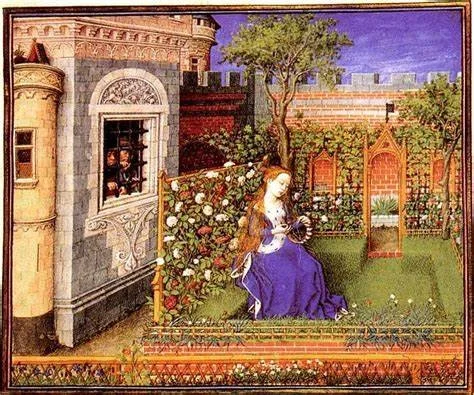
In Chaucer’s “Knight’s Tale,” the first tale in the Canterbury Tales, our hero Palamon flinches when from the window of his prison he sees Emelye.
All the tale derives from this flinch.
This flinch leads to Arcite’s death and Palamon’s marriage.
He “bleynte” (flinched) from the sight of Emelye, as one flinches from a bright sun (line 204).
Bleynte (flinched) and bright are nearly homophones; they are the key words in Chaucer’s tale.
Bright is used as an adjective both for Emelye and for swords: both bright Emelye (line 879) and bright swords (line 1750) lead to death.
Ye sleen me with youre eyen, Emelye! (line 709) (You slay me with your eyes, Emily.)
Both Emelye and Mercury have bright hair.
Mercury, often considered a god of medicine in the late Middle Ages, tells Arcite that his lovesickness will be cured if he returns to Emelye.
Thus Emelye is both the cause of the sickness of love (her brightness compared with the brightness of swords that slay) and its cure (her brightness compared with the bright hair of Mercury, the god of medicine).
Bright is also used for the sun; and Emelye is an early riser.
If bright Emelye hadn’t been an early riser, Palamon might not have bleynte at the sight of her.
* Orlando Bartro is the author of Toward Two Words, a comical & surreal novel about a man who loves yet another woman he never knew. Find your copy at Amazon. Hardcover, paperback, and e-book editions available.
https://www.amazon.com/Toward-Two-Words-Orlando-Bartro-ebook/dp/B072MNB4F9