




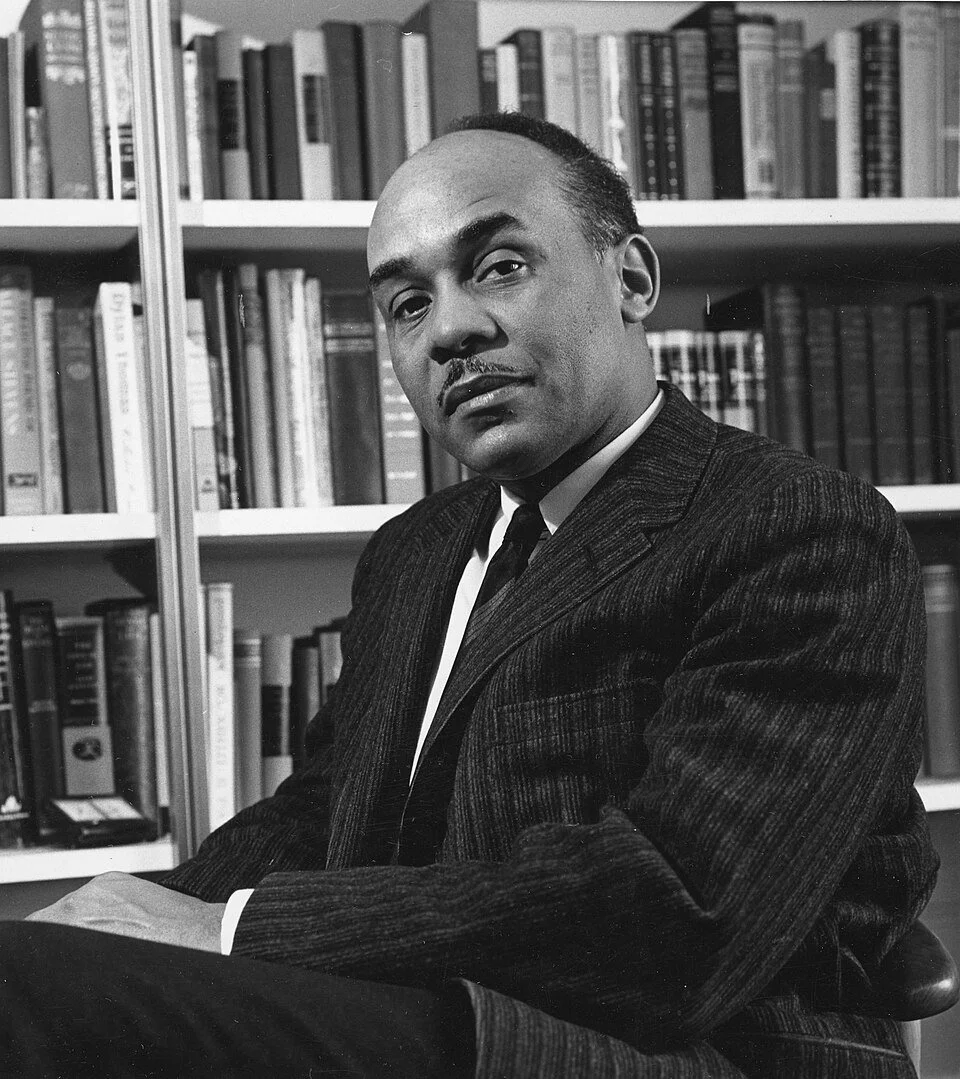
Ralph Ellison’s full name is Ralph Waldo Ellison. He was named after Ralph Waldo Emerson because Ellison’s father loved literature and secretly hoped his son would grow up to be a poet.
Ellison was born March 1, 1913, in Oklahoma City, Oklahoma.
His older brother died in infancy and his younger brother was born in 1916, the same year their father, who was a construction foreman, died after a work-related injury and a failed operation.
In 1921, Ellison’s mother, Ida, moved north with her sons to Gary, Indiana to be near family. She believed they would be safer in a Northern state. After the move, Ida had trouble finding work and her brother lost his job, so they returned to Oklahoma where young Ralph began working as a busboy, shoeshine boy, hotel waiter, and a dentist’s assistant to help support the family. Ellison was also interested in audio technology. He liked taking radios apart and rebuilding them. As an adult, he began customizing hi-fi stereo systems.
He received free music lessons from a neighbor and learned to play trumpet and alto saxophone. These skills helped him become the school bandmaster. He also played football at Douglass High School.
After graduating, Ellison saved up enough money for a down payment on a trumpet, so he could play with local musicians and continue taking music lessons. This investment allowed Ellison to earn admission to Tuskegee Institute, the prestigious all-black university in Alabama founded by Booker T. Washington. Ellison applied previously and was not accepted, but when the university orchestra needed a trumpet player, his skills saved the day. He hopped freight trains to get from Oklahoma to Alabama.
Ellison was disappointed to find that many of his fellow students were from class-conscious affluent black families. He felt a similar sense of isolation at the university as he felt at predominantly white institutions.
Ellison studied music and spent most of his free time at the university library reading modernist classics like T.S. Eliot’s The Wasteland.
In 1934, he became a desk clerk at the university library. The extra income was helpful, and he was able to read the works of favorite authors such as James Joyce, Thomas Hardy, Gertrude Stein, and Fyodor Dostoevsky. He left the university in 1936 without a degree.
His marriage to actress Rose Poindexter lasted from 1938-1943.
Ellison moved to Harlem in New York City where he met Lanston Hughes. Hughes was one of a few black authors who could make a living from his writing. He introduced Ellison to the black literary establishment. It’s members included Richard Wright and Romare Bearden. After Elison wrote a review of one of Wright’s books, Wright encouraged him to continue writing reviews and to begin writing fiction.
Elison’s first story, “Hymie’s Bull,” was inspired by his experiences hopping trains with his uncle. Ellison’s stories were as popular as his reviews and by 1944, he had more than 20 reviews, articles, and short stories published in magazines.
In 1948, he collaborated with photographer Gordon Parks on the photo essay, “Harlem is Nowhere,” about the first racially integrated psychiatric clinic in Harlem. Ellison’s essay, “The Pictorial Problem” addressed the power of images to influence viewers’ opinions and perceptions of people and events.
Richard Wright was affiliated with the Communist Party, and Ellison began writing and editing for communist publications. Both men became disillusioned with the Communist Party during World War II for abandoning African Americans’ struggles for equality, equity, and inclusion in favor of Marxist class politics. This inspired Ellison to begin writing, Invisible Man, his most acclaimed work.
Toward the end of the war, he enlisted in the U.S. Merchant Marine.
In 1946, he married Fanny McConnell, a writer for The Chicago Defender, and the founder of the Negro People’s Theater in Chicago. She also worked for American Medical Center for Burma Frontiers, a non-profit supporting medical missionary work.
Though Ellison continued writing reviews, and he contributed lyrics to several songs, McConnell financially supported him while he worked on Invisible Man. She typed and helped edit his manuscript.
Invisible Man was published in 1952. It explores an unnamed African American man’s search for identity while being forced to navigate different types of racial prejudices in the North and South. In contrast to Richard Wright’s work and James Baldwin’s work, Ellison’s characters are educated, self-aware, and articulate. He explores emotional invisibility, the feeling of not being seen or heard because of his race and economic status. In 1953, it won the National Book Award for Fiction.
In 1962, American physicist Herman Kahn recruited Ellison to work for the Hudson Institute, a conservative think tank that originally developed theories about domestic and military use of nuclear power and nuclear war survival scenarios. Kahn and his co-founders didn’t want the institute’s research to remain limited to the military and defense, so they began recruiting consultants with diverse backgrounds to study social, geo-political, economic, and demographic issues.
Ellison completed Shadow and Act in 1964, a collection of social, political, and critical essays and in 1986, he published Going to the Territory, a collection of seventeen essays about the southern novelist William Faulkner, author Ricard Writght, musician Duke Ellington, and the contributions of African Americans to America’s national identity.
Ellison was admitted to the American Academy of Arts and Letters, and he was awarded President’s Medals from Lyndon Johnson and Ronald Reagan. France awarded him a State Medal. He received an honorary Doctorate from Harvard University, and he became the first African American admitted to the Century Association, a private social, arts, and dining club in New York City.
In 1992, he was awarded a special achievement award from the Anisfield -Wolf Book Awards in recognition of his work as a musician, sculptor, photographer, author, and college professor. He taught at Bard College. Rutgers University, the University of Chicago, and New York University. He was also a charter member of the Fellowship of Southern Writers.
After his death in 1994, several of his manuscripts were discovered and published posthumously including Juneteenth and Three Days Before the Shooting. In 2014, the USPS honored Ellison by placing his image on a stamp as part of its Literary Arts series.
Selected Works by Ralph Ellison:
Novels:
Invisible Man (1952)
Flying Home and Other Stories (1996)
Juneteenth (1999)
Three Days Before the Shooting (2010)
Essay Collections:
Shadow and Act (1964)
Going to the Territory (1986)
The Collected Essays of Ralph Ellison (1995)
Living with Music: Ralph Ellison’s Jazz Writings (2001)
Letters:
Trading Twelves: The Selected Letters of Ralph Ellison and Albert Murray (2000)
The Selected Letters of Ralph Ellison (2019)