





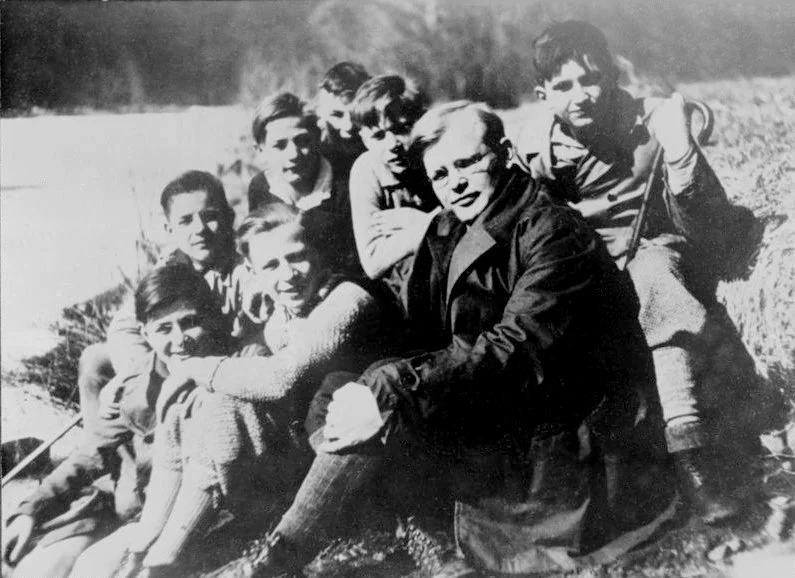
On the morning of April 9, 1945, in the gray chill before sunrise, they came for him.
The Third Reich was collapsing. Soviet artillery thundered in the east. American forces were crossing the Rhine. The empire that had promised a thousand years was gasping through its twelfth. And yet, in the yard of Flossenbürg concentration camp, the machinery of execution still functioned with bureaucratic precision.
Dietrich Bonhoeffer was led from his cell, stripped, and taken to the gallows. He was thirty-nine years old.
Witnesses later recalled his composure. A camp doctor, no sympathizer to the condemned, wrote that he had seldom seen a man die so entirely submissive to the will of God. Bonhoeffer knelt and prayed. Then he mounted the scaffold. The trap was sprung.
Bonhoeffer had not begun life as a likely martyr. He came from privilege. His father, Karl Bonhoeffer, was one of Germany’s most respected psychiatrists, his mother, Paula, the daughter of theologians. The Bonhoeffer household was cultivated and intensely intellectual—music in the rooms, books lining the walls, dinner conversations ranging from philosophy to science. Religion, however, was not the career his family expected him to pursue.
When the young Dietrich calmly announced that he intended to study theology, his older brother reportedly scoffed that the church was little more than a weak and outdated institution. Bonhoeffer answered with quiet determination:
“Then I shall reform it.”
The meaning of that vow was still forming. A few years later, while studying in Rome, Bonhoeffer witnessed something that began to give it shape. At Catholic Mass he saw rich and poor, scholars and laborers, kneeling together at the same altar. This was not how the church in Germany looked. Here, he later reflected, was a vision of a church that transcended nation and tribe.
Bonhoeffer never became a Catholic—he remained firmly Lutheran—but the experience left its mark.
Soon afterward Bonhoeffer crossed the Atlantic. In 1930 he spent a year studying in the United States at Union Theological Seminary in New York. But much of what he encountered there left him unimpressed. American seminaries, he complained, spoke endlessly about social issues but seemed strangely hesitant to proclaim the central message of the faith.
“In New York,” he wrote, “they preach about nearly everything… only one thing is not addressed: the Gospel of Jesus Christ.”
Yet outside the lecture halls he encountered something that would shape him deeply. In Harlem he began attending Abyssinian Baptist Church, where he heard the powerful preaching of Adam Clayton Powell Sr. There Bonhoeffer encountered a Christianity forged in suffering and alive with conviction. He listened to spirituals born from generations of struggle, taught Sunday school to Black children, and watched a congregation worship with a seriousness that both surprised and moved him.
By the time he returned to Germany, his future seemed assured. At twenty-five he was already lecturing in Berlin. A prestigious academic life lay open before him—lecture halls, books, and the quiet authority of a rising theologian.
Then came 1933.
When Adolf Hitler was appointed chancellor in January, much of Germany exhaled. Stability, they hoped. Renewal. National pride restored. Within weeks the Reichstag burned, civil liberties vanished, and political opponents were arrested.
Two days after Hitler consolidated power, Bonhoeffer stepped before a radio microphone. The young theologian spoke calmly but with unmistakable urgency. Germany, he warned, was in danger of confusing leadership with idolatry. A true leader must serve the people and point them beyond himself. But when a leader allows himself to be worshiped, something terrible happens.
“The leader who lets himself be idolized,” Bonhoeffer said, “becomes the misleader.”
In a nation already beginning to chant the word Führer, the warning was unmistakable.
Before he could finish, the broadcast suddenly went dead. Whether the microphone was cut intentionally or by accident remains unclear.
Meanwhile, much of the German church did not resist. Large segments adapted. Some pastors donned Nazi insignia. Others preached obedience to the regime as a Christian duty. The cross and the swastika appeared in uneasy proximity.
Bonhoeffer would not go along.
From pulpits and lecture halls he warned that the church had no right to bow before political power. The church existed to proclaim Christ—not to bless the ambitions of the state. Christianity, he insisted, must confront injustice. When some argued the church should remain “above politics,” Bonhoeffer answered that neutrality in the face of oppression was itself surrender.
“The church,” he declared, “must not simply bandage the victims beneath the wheel, but jam a spoke in the wheel itself.”
Bonhoeffer broke away from the German church, helping form what became the Confessing Church, a movement insisting that Christ—not the state, not the Führer—was Lord. In 1935 he opened an underground seminary at Finkenwalde, training pastors in a disciplined Christian life shaped by prayer, confession, and community. But the regime noticed. In 1937 the Gestapo shut the school down and banned him from teaching or publishing.
Even then Bonhoeffer hesitated to embrace violence. In those years he spoke often of peace and the Christian duty to renounce war. But as the machinery of the regime tightened—Jews stripped of rights, synagogues burned in the terror of 1938, churches bent into submission—he began to conclude that faithfulness might demand something more. The question, he wrote, was not how a man might keep his conscience perfectly clean, but how the coming generation is to live. And as Bonhoeffer later declared in words that would echo through the dark years of the Third Reich, worship itself meant nothing if Christians ignored the suffering of their neighbors:
“Only he who cries out for the Jews may sing Gregorian chants.”
Still, he was no revolutionary. Not yet.
In 1939, on the eve of war, Bonhoeffer traveled to the United States. Friends urged him to remain there. He was already under suspicion. America was safe. Germany was descending into catastrophe. Yet within weeks he returned home.
“I have made a mistake,” he wrote. “I must live through this difficult period of our national history with the Christian people of Germany.”
Something in Bonhoeffer hardened at this point. Through family connections, the once-pacifist-preacher became linked to elements within German military intelligence that were plotting against Hitler. The Abwehr had become an unlikely shelter for this group of dissenters—officers who outwardly served the regime while secretly working to undermine it.
At first Bonhoeffer acted as courier and intermediary, traveling under the cover of intelligence work to carry messages between resistance figures and contacts abroad. Through the same network he helped arrange the escape of several Jews from Germany, using Abwehr resources to move them across the border into Switzerland.
But within the circle the stakes were rising. Plans multiplied. Explosives were obtained. Killing Hitler, once whispered only in theory, became the central objective.
In March 1943 they managed to place a bomb aboard Hitler’s aircraft after a visit to Smolensk. The device failed to detonate. Days later a brave German officer stood ready to kill himself beside Hitler with explosives hidden beneath his coat, but the opportunity vanished when the dictator abruptly left the building.
Again and again the moment slipped away.
In April 1943, the Gestapo arrested Bonhoeffer. The charge involved helping Jews escape Germany and irregularities in funds flowing through the Abwehr. The money had been traced back to him. Yet the authorities still did not see the full picture. For more than a year the wider conspiracy against Hitler remained hidden while Bonhoeffer sat in a Berlin military prison, reading, writing letters, and waiting.
Then, on July 20, 1944, a bomb exploded in Hitler’s headquarters at the Wolf’s Lair. The attempt failed again. Hitler survived. But this time the investigation that followed tore through the German resistance like a storm. Documents were uncovered. Names surfaced. Networks unraveled. And eventually the trail led back to Bonhoeffer.
The relatively mild confinement of Tegel Prison now gave way to something darker. He was transferred into the custody of the Gestapo and eventually moved through the collapsing Reich—from prison cells to the concentration camps of Buchenwald and finally Flossenbürg.
In his earlier cell he had written letters that would later be collected and published, reflections that became some of the most influential Christian writings of the twentieth century—meditations on faith in a “world come of age,” fragments of hymns, and hard reflections on suffering. “Only a suffering God can help,” he wrote. “Christ saved the world not by avoiding suffering, but by entering it.”
The theologian had not disappeared. But he was no longer merely a theologian. He was a man who had wagered his life that evil must be confronted, not merely endured.
By April 1945 the war was plainly lost. American troops were less than two weeks from the camp. But Hitler, in his bunker in Berlin, demanded final vengeance against all traitors. Orders went out. Files were reviewed. Names were marked.
Bonhoeffer’s was among them.
At dawn on April 9, he was hanged with other conspirators. One witness later remembered Bonhoeffer’s final words: “This is the end—for me the beginning of life.”
Three weeks later, Hitler would shoot himself. The Reich would collapse into rubble. Germany had followed the false idol of the Führer, and the result was division, occupation, and ruin.
It is tempting to tidy his story—to make him a saint without contradiction. But that would dishonor him. He was not pure in the abstract. He was conflicted. He wrestled. He crossed lines he once thought uncrossable. He believed that in a world bent by radical evil, moral innocence might itself become guilt.
That is the tension.
When does obedience become complicity?
When does resistance require force?
What does faith demand when the state demands worship?
Bonhoeffer did not answer those questions in theory. He answered them with his life.
When the wheel of injustice crushes the innocent, there may come a moment when conscience demands more than tending the wounded. It demands that someone step forward—and jam a spoke in the wheel.
Tony Valerino is an author and independent researcher focused on American history and Western civilization. He has published two books, his most recent a history of the United States told through turning points that shaped the nation’s people and institutions. He also writes daily historical essays and reflections on his blog. Links below.
Pivotal Moments That Shaped America - https://a.co/d/g6qjSrw
Facebook blog - https://www.facebook.com/share/1FNLF42a8K/?mibextid=wwXIfr
Civilizations of the Ancient World - https://a.co/d/e65mKDD
Photo Credit:
By Bundesarchiv, Bild 183-R0211-316 / CC-BY-SA 3.0, CC BY-SA 3.0 de, https://commons.wikimedia.org/w/index.php?curid=5436013