





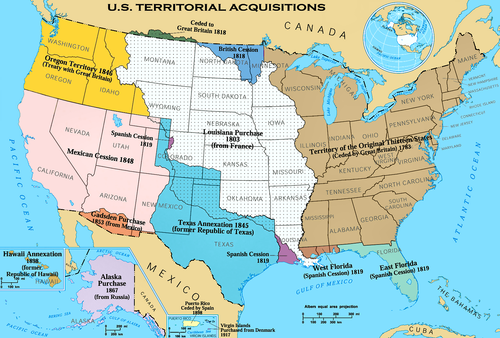
The original thirteen colonies which make up the original thirteen states of the United States of America are typically divided into three geographical regions. Virginia, the oldest colony was established in 1607. All thirteen colonies technically became states in July 1776 after agreeing to the United States Declaration of Independence, and each joined the first union of states between 1777 and 1781 upon ratifying the Articles of Confederation, its first constitution.
In the 1783 Treaty Of Paris, which ended the American Revolutionary War, Britain ceded its land claims east of the Mississippi to the United States without consulting Native American Tribes who lived on the land. Even though Britain could not legally transfer Indigenous-owned lands, the treaty allowed the United States to claim authority over the ceded lands setting up future conflicts with the Native Americans they continued to push farther west.
The order of statehood we recognize is the order in which representatives from each state ratified the 1787 Constitution which replaced the Articles of Confederation.
New England colonies:
Massachusetts (est. in 1620) became the sixth state to ratify the Constitution on February 6, 1788
New Hampshire (est. in 1623) became the ninth state to ratify the Constitution on June 21, 1788 - after ratification by nine states, the Constitution became legal.
Connecticut (est, in 1635) became the fifth state to ratify the Constitution on January 9, 1788
Rhode Island (est, in 1636) became the thirteenth state to ratify the Constitution on May 29, 1790
The Middle Colonies:
New York (est, in 1624) became the eleventh state to ratify the Constitution on July 26, 1788
Delaware (est, in 1638) became the first state to ratify the Constitution on December 7, 1787
New Jersey (est, in 1660) became the third state to ratify the Constitution on December 18, 1787
Pennsylvania (est. in 1681) became the second state to ratify the Constitution on December 12, 1787
The Southern Colonies:
Virginia (est. in 1607) became the tenth state to ratify the Constitution on June 25, 1788
Maryland (est. in 1634) became the seventh state to ratify the Constitution on April 28, 1788
North Carolina (est. in 1663) became the twelfth state to ratify the Constitution on November 21, 1789
South Carolina (est. in 1663) became the eighth state to ratify the Constitution on May 23, 1788
Georgia (est. in 1733) became the fourth state to ratify the Constitution on January 2, 1788
As immigrants continued to flock to American shores, settlements began pushing westward.
Vermont became a state March 4, 1791, followed by Kentucky on June 1, 1792, and Tennessee on June 1, 1796.
In 1803, President Thomas Jefferson negotiated a treaty with France to purchase the Louisianna Territory for $15 million. Native tribes who had lived on this land for centuries were not consulted. The Louisianna Territory, 828,000 square miles of land west of the Mississippi River doubled the size of the United States stretching from the Mississippi River to the Rocky Mountains and from the Gulf of Mexico to the Canadian border.
Jefferson’s first task after acquiring the territory was to send Merriweather Lewis and William Clark on an expedition to discover a route to the Pacific Ocean. They returned in 1806 with drawings and maps after completing their mission.
On March1, 1803, Ohio became the seventeenth state.
Louisiana became a state on April 30, 1812, a little over a month before the official beginning of the War of 1812 (aka the Second American Revolution).
The War of 1812 lasted until 1815. It was a military conflict between the United States and the British Empire and their First Nations (Native American) allies. Several factors led to the war:
· Britain was at war with France and tried to impose trade restrictions with France. The U.S. considered the restrictions to be illegal.
· The U.S. also objected to British impressment of captured American sailors into the British Royal Navy.
· British military troops were offering support for American Indian tribes who were offering armed resistance against U.S. expansion of the American frontier in the Northwest Territory.
· Britain believed the U.S. wanted to annex parts or possibly all of Canada.
· The U.S. was trying to save face after the Chesapeake-Leopard affair in which the crew of HMS Leopard pursued, attacked, and boarded the American ship under the guise of searching for British deserters from the Royal Navy. The American commander, James Barron, surrendered his ship after firing only one shot.
Native American resistance impeded American expansion into the Northwest Territory, Ohio, Indiana, Michigan, Illinois, Wisconsin, and northeast Minnesota. The British wanted to create a large neutral Native American state covering most of Ohio, Michigan, and Indiana to create a barrier between the Western U.S. and Canada and block American Expansion. Britain intended to oversee the area instead of ceding control to Native American tribes. At the Ghent Peace Conference in 1814 they included it with their terms for peace, but after losing key battles in the war, the demand was unsustainable.
After the War of 1812 ended, Britain, the United States and Canada all claimed victory. Probably the only losers in the altercation were Native American tribes whose land continued to be parceled off.
Indiana became the nineteenth state on December 11, 1816, followed by Mississippi on December 10, 1817, Illinois on December 3, 1818, and Alabama on December 14, 1819.
Opposition to slavery was growing in the North. Legislators attempted to block the spread of slavery by refusing to allow slavery to spread into the new territories. The Missouri Compromise (aka Compromise of 1820) was federal legislation that attempted to appease southern slave states and the northern states desire to end the spread of slavery. Missouri was admitted as a slave state and Maine as a free state, It also prohibited slavery in the remaining Louisianna Purchase lands north of the 36◦30’ parallel. The legislation passed on March 3, 1820.
The Missouri Compromise served as a twenty-year band aid. During that period, Maine was admitted on March 15, 1820, and Missouri on August 10, 1821. Arkansas was admitted as a slave state on June 15, 1836, followed by the free state of Michigan on January 26, 1837.
Under the 1830 Indian Removal Act, the federal government gave itself the power to negotiate with Native American tribes living east of the Mississippi to get them to move to lands in present-day Oklahoma. Negotiations devolved into pressure and the use of force. Cherokee, Muscogee (Creek), Chickasaw, Choctaw, and Seminole tribes were forcibly relocated. Along the way, thousands died of starvation, disease, exhaustion, and exposure. Many perished along the route referred to as the Trail of Tears.
Tensions resumed in the 1840s as Florida was admitted as a slave state on March 3, 1845, followed by Texas, another slave state, on December 29, 1846. On December 28, 1846, Iowa became a free state followed by Wisconsin on May 29, 1848.
In 1845, John O’Sullivan, a journalist coined the term Manifest Destiny to describe the push to expand the United States’ borders from the Atlantic Ocean to The Pacific Ocean. Unfortunately, Native Americans and other indigenous cultures didn’t fit with the narrative. Settlers continued to encroach on Indian territories. The U.S. government offered land and sovereignty to tribes then reneged on treaties to make room for more settlers heading West.
The California gold rush (1848-1855) brought 300,000 people from the rest of the United States and abroad to California.
The Compromise of 1850 briefly diffused tensions between the North and the South. The five separate bills proposed by Henry Clay included how to handle slavery in recently acquired territories from the Mexican American War (1846-1848). The provisions honored California’s request to become a free state on September 9, 1850, and banned slave trade in Washington, D.C., but not slaveholding. In return, stronger fugitive slave laws were approved. The Fugitive Slave Act of 1850 required all escaped slaves to be returned to slaveholders and required officials and citizens of free states to cooperate or be arrested. The Act greatly contributed to the founding of the original Republican Party and the start the American Civil War.
The Compromise defined northern and western borders for Texas and established a territorial government for the Territory of New Mexico and the Territory of Utah with no restrictions on future states becoming free states or slave states.
President Zachary Taylor and anti-slavery Whigs opposed the compromise. Pro-slavery Democrats like John C. Calhoun supported it. Congressional debates dissolved in shouting matches, fist fights, and the drawing of weapons. After President Taylor’s death, he was succeeded by Millard Fillmore who allowed Stephen A. Douglas to ram the legislation through Congress. The Compromise of 1850 briefly postponed the war by placating the southern states.
The 1853 Gadsden Purchase involving the areas now know as Arizona and southwestern New Mexico gave America more land that previously belonged to Indigenous Mexicans and Native Americans. It was the final substantial territorial acquisition in the contiguous United States.
On May 11, 1858, Minnesota became a free state followed by Oregon on February 14, 1859.
Tensions resumed after the 33rd U.S. Congress passed the Kansas-Nebraska Act (1854) and President Franklin Pierce signed it into law. The Kansas-Nebraska Act repealed the Missouri Compromise of 1820 igniting a series of armed conflicts that became known as “Bleeding Kansas” as pro-slavery and anti-slavery forces flooded the territory to establish a majority to settle the issue of slavery in Kansas. Kansas became a state on January 29, 1861, less than three months before the start of the American Civil War.
West Virginia was admitted to the Union as a slave state on June 20, 1863. It became an important border state during the war after separating from Virginia. Some West Virginians owned slaves, but most were propertied farmers and the provisions placed in their state constitution allowed for the gradual abolition of slavery. In 1863, its state government abolished slavery and ratified the 13th Amendment.
On October 31, 1864, Nevada became the only other state admitted to the Union during the war.
After the war, many freed slaves headed West and North hoping to escape the racial tensions in the South.
After the Civil War, westward expansion continued as Nebraska became the 37th state on March 1, 1867, followed by Colorado on August 1, 1876, North Dakota and South Dakota on November 2, 1889, Montana on November 8, 1889, Washington on November 11, 1189, Idaho on July 7, 1890, Wyoming on July 10, 1890, and Utah on January 4, 1896.
At the start of the twentieth century, Oklahoma became the 46th state on November 16, 1907. It was followed by New Mexico on January 6, 1912, and Arizona on February 14, 1912.
The push for Alaskan statehood began in 1916; however, there was little interest by Alaskans, so the proposal was shelved until 1943. In 1947 and 1950, President Harry Truman wanted to make Alaska the 49th state, but that wouldn’t happen until the Eisenhower administration. On January 3, 1959, Alaska became a state.
In 1893, the United States backed the overthrow of the Hawaiian monarchy. It became a U.S. territory in 1900. During the 1950s, a coalition of prominent Asian American politicians began pushing for statehood to end Hawaii’s status as a politically disenfranchised territory. On August 21, 1959, Hawaii became the 50th state. It’s presence proved invaluable to the Civil Rights movement because Hawaiian politicians were in favor of desegregation and civil rights.
The United States currently has 16 territories, but only five of them are permanently inhabited, Puerto Rico, U.S. Virgin Islands, Guam, American Samoa, and Northern Mariana Islands.
Will you see more stars added to the flag in your lifetime?
Should Washington, D.C. become a state?
Things to consider as we celebrate 250 years.