




The Battle of Gettysburg took place between July1-3, 1863 around Gettysburg, Pennsylvania. Union soldiers prevailed against Confederate forces, and this victory is widely considered the turning point of the American Civil War.
It was the bloodiest battle fought on American soil up to that date claiming over 50,000 combined casualties.
Major General George Meade’s Army of the Potomac defeated General Robert E. Lee’s Army of Northern Virginia stopping Lee’s invasion of the North and forcing his retreat. Meade’s forces were estimated at between 93,500-104,256 soldiers with weapons, 360 artillery pieces and 36 calvary regiments. Lee’s forces included 65,000-80,000 soldiers with weapons, 270 artillery pieces, and 9,500 calvary. Union casualties were around 23,000 (@22-25%) with 3,150 killed, while Confederate casualties were between 23,000-28,000 (@35%) with 3,900 killed.
Enroute to Gettysburg, Confederate soldiers kidnapped between 40-60 free black civilians and sent them south into slavery. Lee intended to reach Harrisburg or Philadelphia by the end of summer shifting the fight from war-ravaged Northern Virginia to force the North to end the war.
Originally, President Lincoln intended to send Major General Joseph Hooker to intercept Lee, but he relieved Hooker of command three days before the Battle of Gettysburg and replaced him with Meade. Brigadier General John Buford commanded the Union cavalry forces protecting low ridges to the northwest of Gettysburg. Two corps of Union infantry forces were sent as reinforcements. The hastily formed Union lines collapsed, and Confederate forces pushed retreating Union troops south of the city.
On day two of the battle, the line of Union forces was laid out in a defensive fishhook formation. Lee launched a heavy attack on the Union’s left flank moving the fighting to Little Round Top, the Wheatfield, Devil’s Den, and the Peach Orchard. Confederate forces attacked the Union’s right flank on Culp’s Hill and Cemetery Hill, but Union forces held.
On day three, infantry battles continued on Culp’s Hill and the cavalry engaged in heavy fighting to the east and south of Gettysburg. Pickett’s Charge, a Confederate infantry assault by approximately 12,000 soldiers against the Union line at Cemetery Ridge failed thanks to Union rifle and artillery fire. The Confederates suffered heavy losses forcing General Lee’s troops to retreat back into southern territory.
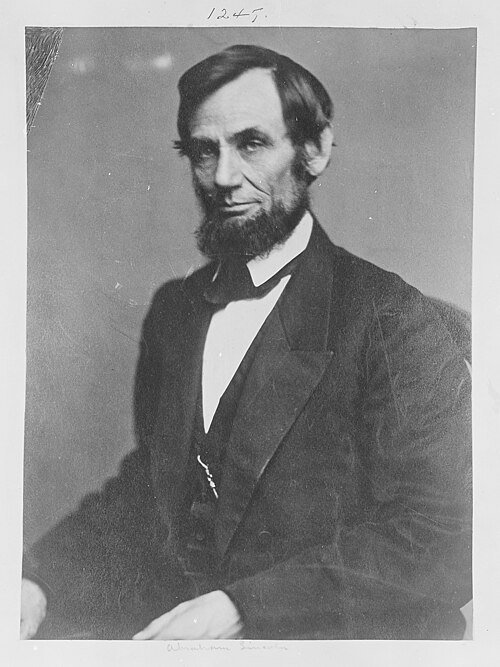
On November 19, President Lincoln traveled to Gettysburg for the dedication of Gettysburg National Cemetery honoring the fallen Union soldiers. Lincoln used the event to redefine the purpose of the American Civil War.
Fifteen thousand people attended the dedication ceremony. The main orator of the day was Edward Everett, an elder statesman who served as a U.S. senator and later governor of Massachusetts and Secretary of State during the Filmore administration. As was the custom of that time period, Everett prepared a lengthy speech of approximately 13,000 words which took him over two hours to deliver. His speech was received favorably.
When Lincoln stood to deliver his speech, he was pale and haggard. Attendees attributed his appearance to the pressures of being a war-time president. In reality, he was battling an undiagnosed case of smallpox.
He spoke for roughly two minutes uttering 271 words forming ten sentences, which would change the course of the American Civil War and history.
He began his speech with a reference to the Declaration of Independence,
“Four score and seven years ago our fathers brought forth on this continent, a new nation, conceived in Liberty, and dedicated to the proposition that all men are created equal.”
Lincoln posited that the American Civil War was a test to our resolve as a nation and a challenge to our founding father’s intentions. He noted the sacrifices of the thousands who died in battle to defend our nation’s principles and insisted that their ultimate sacrifice must remain meaningful. He concluded with,
“That these dead shall not have died in vain – that this nation, under God, shall have a new birth of freedom – and that government of the people, by the people, and for the people, shall not perish from the earth.”
When he finished, the president returned to his seat and the ceremony continued. His words were first recognized for their brevity. The speech was not hailed for its brilliance for several years.
Elegant in their simplicity, those 271 words clearly stated our mission as a nation and our purpose for taking up arms to defend freedom for all Americans. It’s now viewed as one of the most influential speeches ever delivered on the American purpose.
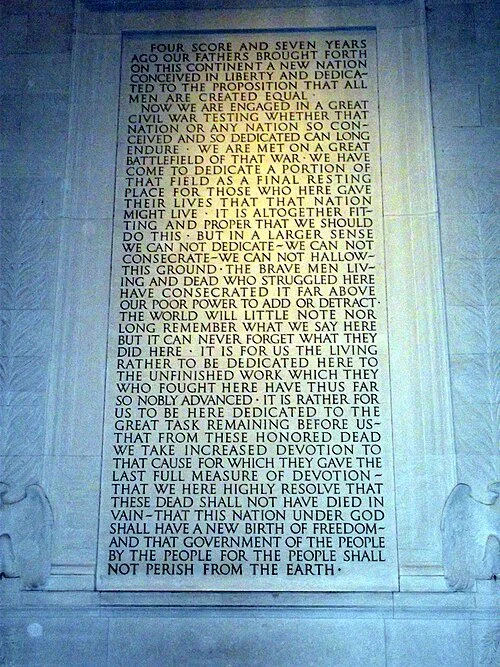
Here is the Bliss version of President Lincoln’s address in its entirety:
Four score and seven years ago our fathers brought forth on this continent, a new nation, conceived in Liberty, and dedicated to the proposition that all men are created equal.
Now we are engaged in a great civil war, testing whether that nation, or any nation so conceived and so dedicated, can long endure. We are met on a great battlefield of that war. We have come to dedicate a portion of that field, as a final resting place for those who here gave their lives that that nation might live. It is altogether fitting and proper that we should do this.
But, in a larger sense, we cannot dedicate – we cannot consecrate - we cannot hallow – this ground. The brave men, living and dead, who struggled here, have consecrated it, far above our poor power to add or detract. The world will little note, nor long remember what we say here, but it can never forget what they did here. It is for us the living, rather, to be dedicated here to the unfinished work which they who fought here have thus far so nobly advanced.
It is rather for us to be here dedicated to the great task remaining before us – that from these honored dead we take increased devotion to that cause for which they gave the last full measure of devotion – that we here highly resolve that these dead shall not have died in vain – that this nation, under God, shall have a new birth of freedom – and that government of the people, by the people, and for the people, shall not perish from the earth.
Sources for this article:
https://www.abrahamlincolnonline.org/lincoln/speeches/gettysburg.htm