





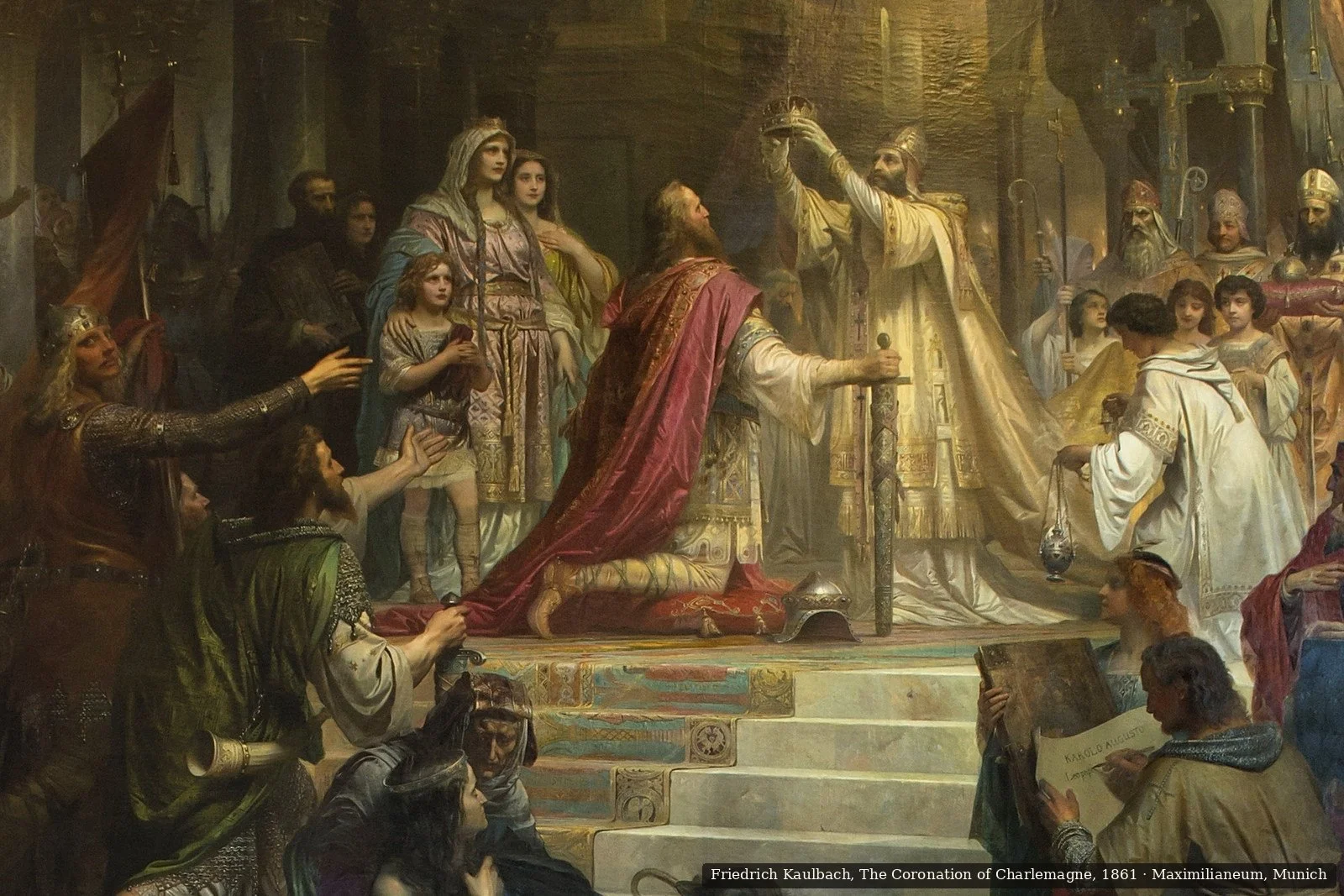
It is November 24, AD 800. Charlemagne, king of the Franks, enters Rome at the head of a
powerful entourage of soldiers, nobles, and bishops.
The day before, Pope Leo III rode twelve miles out of the city to meet him at Nomentum. The
pope welcomed the king with great ceremony and dined with him.
Leo has every reason to be anxious. His enemies have tried to tear out his tongue and gouge out
his eyes. They have accused him of grave crimes. His grip on the papal throne is fragile.
Charlemagne is the one man with the power to protect him.
The Romans know that the king has come to settle an important dispute. They do not yet know
that, one month later, a crown will be placed on his head—and the Western world will forever
change.
. . .
To understand what is coming, one must first understand Charlemagne’s stature.
His name means Charles the Great. For more than thirty years he has ruled the Franks, building a
realm that stretches across much of modern France, Germany, Austria, and northern Italy. No
Western ruler has held such a vast territory since the fall of the Roman Empire.
He is feared as a conqueror and admired as a patron of learning. He rides from battlefield to
monastery with equal ease. At court he gathers scholars from across Europe, encourages
education, and supports learning in monasteries and cathedrals. Under his rule, the Carolingian
Renaissance brings a revival of study and culture to a region that had seen centuries of turmoil.
But Charlemagne’s piety has an iron fist. He believes he is defending Christianity, and he is
willing to use force to spread it. In the long wars against the pagan Saxons, he demands
conversion and punishes resistance with brutal severity. The Frankish annals report that in 782,
after a Saxon revolt, he ordered the execution of thousands of captives at Verden. The precise
circumstances remain debated, but the violence of his campaigns is beyond doubt.
Nearly seven decades earlier, his grandfather Charles Martel had defeated a Muslim force at
Tours. Later generations would celebrate the battle as the moment Christian Europe was saved
from Islamic conquest, though historians still debate how decisive it was. Now Charlemagnerules a Christian kingdom whose influence is expanding across the old Western provinces of
Rome.
Pope Leo III, by contrast, is fighting to survive.
A Roman of modest origins, Leo rose through the Church and became pope in 795. But his
election did not end Rome’s political rivalries. His enemies included powerful men who had
served his predecessor, and they regarded Leo as an outsider who had taken a position they
believed belonged to them.
In April 799, while Leo rode in a procession through the streets of Rome, armed men attacked
him. They knocked him down and tried to injure his eyes and tongue. The assault was meant to
discredit him and remove him from the papal office. But Leo escaped with help from Frankish
supporters and fled north to Charlemagne’s court at Paderborn.
Some accounts later claimed that Leo’s eyes and tongue had been cut out and then miraculously
restored. The accounts differ, but the political danger was plain. Leo had been attacked in his
own city. His enemies had taken up arms against him, and his position as pope was in jeopardy.
At Paderborn, Leo sought Charlemagne’s protection. His accusers sent their own charges. They
accused the pope of serious offenses, including perjury and sexual misconduct. Charlemagne
faced an awkward choice. He had promised to defend Leo, but the pope’s enemies were powerful
Romans, and their accusations could not simply be waved away.
The king sent Leo back to Rome under Frankish protection. He would follow later and hear the
case himself. Leo returned with a military escort and was received with public ceremony, but the
danger had not passed. His accusers were still there. He needed Charlemagne to stand beside
him.
. . .
With Charlemagne in Rome, an assembly of bishops and nobles meets on December 1. The king
presides as they consider the charges against Leo. The question before them is difficult: can a
human court judge the pope, the successor of St. Peter?
The case draws on a long-standing claim that no earthly authority can sit in judgment over a
pope. Earlier church documents had expressed that principle; some were forgeries now
associated with Pope Symmachus, who had faced a rival claimant centuries before. How directly
those documents shape the proceedings in 800 remains debated. But in practice, Charlemagne’s
assembly avoids formally declaring Leo guilty or innocent.On December 23, Leo swears an oath on the Gospels, declaring himself innocent of the charges.
The pope remains in office. His accusers are condemned to death, but Leo pleads for their lives.
Charlemagne commutes their sentences to exile.
Leo survives the crisis, but with Charlemagne’s help. The king has brought an army across the
Alps and presided over the assembly. Leo’s plea changes the fate of his enemies, but
Charlemagne has the power to grant it. The balance of power in Rome is unmistakable: Leo
holds the papal office, while Charlemagne commands the force that keeps him there.
Now the two men approach Christmas.
. . .
On Christmas morning, St. Peter’s Basilica is packed for Mass. Charlemagne kneels in prayer. As
he rises, Pope Leo steps forward and places a crown on his head. Then the Roman people erupt
in acclamation, repeating the words three times:
“To Charles Augustus, crowned by God, great and peaceful Emperor of the Romans, life and
victory!”
In that instant, the king of the Franks becomes the first Western ruler to bear the Roman imperial
title since the collapse of the empire in the West more than three centuries earlier.
Why crown Charlemagne then? The answer lies, in part, across the sea.
The Roman Empire still continues in Constantinople, where Empress Irene rules. She has
governed alone since 797, after overthrowing and blinding her son, Constantine VI. A Frankish
account of the coronation offers a striking justification for crowning another emperor: because a
woman holds the throne, it argues, the imperial title has lapsed among the Greeks.
That is a Western argument, not a neutral description of events. Irene rules the Eastern Empire,
and Constantinople does not accept that its throne is vacant. The claim gave Leo and the Franks a
way to present Charlemagne’s elevation as legitimate: if no emperor ruled in the East, Rome
could crown one in the West.
Charlemagne’s coronation does not give him authority over the Eastern Empire. It establishes a
rival emperor in the West and marks Rome’s political turn toward the Franks for protection. The
pope, once within the orbit of Constantinople, now stands at the center of a new Westernalliance. By crowning Charlemagne, Leo helps give the papacy a lasting role in Western imperial
authority, a precedent later rulers and popes will invoke for centuries.
Rome and the Franks are bound together as part of a Latin Christian West. The Greek-speaking
East and Latin-speaking West remain part of one Christian Church, but they now face rival
centers of imperial power. Their political competition will deepen existing cultural and religious
differences and help widen the divide between East and West.
And then there is the question that has been asked for centuries: Was Charlemagne actually
surprised?
His biographer Einhard later wrote that the king disliked the title so much that he would not have
entered the church if he had known what Leo intended. But historians have questioned whether
the ceremony could really have been planned without Charlemagne’s knowledge. The coronation
may have been discussed in advance, perhaps when Leo first met him at Paderborn.
The Royal Frankish Annals add another telling detail: after the acclamation, Leo performs the
ancient rite of reverence before Charlemagne. The pope places the crown on the king’s head,
then bows before the emperor he has just crowned. The ceremony does not settle who holds
greater authority. It gives both men a claim.
We cannot know exactly what the two men agreed. But the ceremony puts two kinds of authority
on display. The pope crowns the ruler; the ruler commands the army. Neither gesture settles who
stands higher.
. . .
Charlemagne died in 814. Leo followed two years later.
Charlemagne’s empire would fracture, but the coronation’s precedent endured. In the West, pope
and emperor would stand as distinct powers within a Christian society—bound together, yet each
capable of challenging the other. This was no modern separation of Church and State. But it was
the beginning of a distinctive political struggle that would shape Europe for centuries.
Did the emperor’s authority come from the pope who crowned him, or did the pope’s safety
depend on the emperor who protected him?
On Christmas morning, Leo did both: he crowned the king who had saved him, then bowed before the emperor he had made.

Tony Valerino is an author and independent researcher focused on American history and Western civilization. He has published two books, his most recent a history of the United States told through turning points that shaped the nation’s people and institutions. He also writes daily historical essays and reflections on his blog. Links below.
Pivotal Moments That Shaped America - https://a.co/d/g6qjSrw
Facebook blog - https://www.facebook.com/share/1FNLF42a8K/?mibextid=wwXIfr
Civilizations of the Ancient World - https://a.co/d/e65mKDD